Statistical Data. Crimea. Crimean Tatars
DOI:
10.13140/RG.2.2.17817.07528
November 10, 2025
This study presents a critical analysis of official population census data for Crimea (2001, 2014, 2021) in the context of Crimean Tatar national demographics. Based on comparison of archival documents, 18th-century diplomatic sources, verified demographic data collected by the Interregional Demographic Commission of the Crimean Tatar Nation (1957–1974) from genocide survivors within sites of forced detention, and mathematical analysis of statistical anomalies, the study formulates a hypothesis of systematic undercounting of Crimea’s autochthonous nation. The research identifies key methodological problems in official censuses and proposes alternative estimates, according to which the actual number of Crimean Tatars in Crimea in 2025 may reach from 500,000 to 800,000 people, and including the global diaspora — more than 8 million people.
Keywords: Crimean Tatars, population census, Crimean demographics, indigenous people, statistical manipulation, Crimean Khanate, Crimean Nation’s Republic, AçlikQirim-genocide 1921-1923, Genocide of Crimean Tatars 1932-1933, Sürgün 1944, diaspora, genocide, autochthonous rights.
The question of the actual number of Crimean Tatar nation remains one of the most politicized and systematically obscured issues in contemporary demographics. Official statistics claim that Crimean Tatars have consistently constituted 10–15% of Crimea’s population throughout 30 years of mass ingathering to their ancestral homeland. This thesis contradicts basic demographic patterns. This thesis contradicts basic demographic patterns. With high birth rates, ongoing homecoming of the exiled nation, and no new forced transfer, the population share cannot remain unchanged. According to the 2013 OSCE report, Crimean Tatar children already constitute 20% of the school population, while Crimea’s overall population is declining at −0.4% per year, whereas the Crimean Tatar population continues to grow at +0.9% per year.
The evidence of systematic undercounting is corroborated by analysis of UNHCR projections from 1997. According to the UNHCR report ‘Crimea: Integration and Development,’ by the end of 1996 Crimean Tatars already constituted 11.9% of Crimea’s population (~261,000 people), and it was projected that their share would grow to 17% by 2005 (~374,000 people). This projection was based on the unique demographic characteristics of the Crimean Tatar population.
The UNHCR report documented a critical demographic disparity: “Only the Crimean Tatar population is experiencing a positive level of population growth of 6 per thousand in 1994, compared to a national average of minus 5.8 per thousand.” This differential of +11.8‰ between Crimean Tatar population growth (+6‰) and overall Crimean population decline (−5.8‰) mathematically necessitated an increasing share of Crimean Tatars in the total population.
The critical anomaly is evident: between 1996 (261,000 according to UNHCR) and 2001 (248,200 according to the census), the official Crimean Tatar population decreased by 13,000 people — despite continued repatriation and positive natural growth. This is mathematically impossible without systematic undercounting. The gap between UNHCR’s projection for 2005 (374,000) and the actual 2001 census figure (248,200) constitutes 126,000 people — a coefficient of 1.51:1.
International organizations documented the ingathering process in detail. UNHCR Refugees Magazine (1997) estimated that 280,000 Crimean Tatars had already gathered in their ancestral homeland, with a similar number expected to follow. The Council of Europe report (Lord Ponsonby, 1999) estimated the total Crimean Tatar nation at 400,000–550,000 people, of whom approximately 260,000 had joined the ingathering by that date.
The UNHCR 1997 report documented the demographic structure of the Crimean Tatar population, which further confirms the impossibility of population share stagnation: “The Crimean Tatar population is overwhelmingly rural (73 percent) and young (an estimated 16 percent is aged 0-16; 51 percent are capable of working, and only 16 percent are pensioners).”
A young population structure with a high proportion of working-age individuals (51%) and children (16%), combined with positive population growth (+6‰) versus negative overall Crimean growth (−5.8‰), mathematically necessitates an increasing share of Crimean Tatars in the total population. The persistent official figure of ~10% is therefore statistically impossible and constitutes evidence of systematic undercounting.
The Council of Europe report (Lord Ponsonby, 1999) provides a critical independent estimate: “To date, roughly 260,000 of the estimated 400,000-550,000 Crimean Tatar population have returned.” This estimate of 400,000-550,000 total Crimean Tatars aligns with the Crimean Tatar National Movement’s documented figure of 550,000 ethnic Crimean Tatars.
The convergence of independent sources — UNHCR projections (17% by 2005), Council of Europe estimates (400,000-550,000), and Crimean Tatar National Movement documentation (550,000) — provides corroborating evidence of systematic undercount with a coefficient of approximately 2:1. This coefficient remained consistent from the 1917 census analysis (Interregional Demographic Commission calculation: 2.01:1), through the 1944 genocide data (Interregional Demographic Commission: 2.21:1), to the 2013 OSCE educational statistics (20% vs. 10% = 2.0:1).
According to the All-Ukrainian Population Census of 2001, conducted on December 5, 2001, Crimean Tatars constituted 10.8% (248,200 people).
After the renewed occupation of Crimea by Russia in 2014, the occupation authorities conducted a population census (October 14–25, 2014). According to Rosstat data documented in January 2023, Crimean Tatars constituted 232,540 people (10.6%) in 2014, and 253,540 in 2021. The 2021 population census recorded 253,540 Crimean Tatars. Official Ukrainian authorities and the Mejlis of the Crimean Tatar People expressed doubts about the reliability of the census results. The Levada Center established that 42% of Russians did not participate in the 2021 census.
Note on Data Manipulation: Secondary Russian websites demonstrate accelerating data distortion. For example, awdb.ru currently (December 5, 2025) displays only 202,166 Crimean Tatars 10.57%) — a retroactive reduction of 51,374 persons (20.3%) from the official Rosstat figure of 253,540. This study relies on data documented by Crimean Tatar lawyer Rustem Veliyev in January 2023, based on official Rosstat publications, as primary source material captured before subsequent manipulation.”
This study aims to systematize arguments in favor of the hypothesis of population undercounting and to propose alternative methods of demographic assessment.
According to works of academician P. Keppen “General Population of Russia,” data from the “St. Petersburg Calendar of 1855,” and 18th–19th century sources, the population of the Crimean Khanate was 7.2 million people in 1650. According to the records of the French consul to Crimean Khan Qırım Giray, Baron François de Tott, in 1767 — 16 years before the illegal occupation by the Russian Empire — the total population of the Crimean Khanate was 4 million people. According to the calculations of researcher R. Kurtiev, approximately 95% of Crimea’s population in 1778 were Crimean Tatars.
Data from the Interregional Demographic Commission of the Crimean Tatar Nation (1973–1974), published in Z. Bekirova’s collection, indicates that the population of the Crimean Khanate demonstrated sustained growth: from 1.0–1.5 million in 1500 to 7.2 million in 1650 — a 5–7 fold increase over 150 years. Comparative analysis of world demographic history shows that this indicator is not only realistic but moderate. For comparison: Israel’s population grew 12.5 times in 77 years (1948–2025), the United States — 19.5 times in 110 years (1790–1900), Australia — 59 times in 170 years (1851–2021), and the Australian state of Victoria during the gold rush increased its population 7 times in just 10 years (1851–1861) .
Thus, the demographic growth of the Crimean Khanate fully corresponds to world practice and is confirmed by comparable examples of prosperous states with developed economies, favorable climates, and stable trade connections. The national state of the Crimean Tatars, with its sustainable diversified economy — developed animal husbandry, arable farming, horticulture, inexhaustible reserves of high-grade salt — a well-trained quarter-million cavalry army, and stable trade, political, and spiritual ties with the states of Asia, Europe, and Africa, possessed all the prerequisites for such demographic growth.
“The national state of the Crimean Tatars with a stable economy — developed animal husbandry, farming, gardening, inexhaustible reserves of high-grade salt — a well-trained quarter-million cavalry army, with stable trade, political, and spiritual ties with states of Asia, Europe, and Africa, constituted a formidable force.”
The Russian census of 1835 recorded that the predominantly Muslim Crimean Tatars constituted 83.5% of the peninsula’s population, while ethnic Russians constituted only 4.4%. By 1897, the share of Crimean Tatars had decreased to 36%, while the share of Russians had increased to 33% — a seven-fold increase in 60 years, which indicates a deliberate occupation policy.
The signing of the Treaty of Küçük Kaynarca (1774) and the forced termination of the protective alliance between the Crimean Khanate — a sovereign state with its own treasury, military forces, economy, and cultural heritage, comparable to any European state — and the Ottoman Empire, in practice meant depriving the Crimean Khanate of external political protection and establishing the preconditions for the subsequent unlawful occupation and the destruction of its national group, in whole or in part, as such.
The so-called “special pokhody” — by genocide perpetrators Suvorov, Minich, Lacy, and others — constituted systematic killing of the civilian population in whole or in part as such. The strategic objective of the genocide was to “prepare” Crimea as a scorched, “empty” territory suitable for the unlawful implantation of settlers from the central villages of Russia. By 1783, Crimea had been “prepared”: over 1,000 districts burned, crops destroyed, livestock driven off.
The genocide is evidenced by the results of the so-called census conducted by decree of Catherine II immediately after the illegal occupation of Crimea. According to the data of Baron General Otto Heinrich von Igelström, the population of the territory of the Crimean Khanate was 140,000 people.
Igelström’s census data should be regarded not as objective demographic statistics but as an instrument of genocide concealment. The figures prepared at the order of the occupiers were intended to openly cover up — the destruction of millions of civilians through targeted lethal pokhody. The undercount of survivors made it possible to present Crimea as a sparsely populated territory, so that occupier’s ” appropriation” of it would appear not as the unlawful implantation of settlers onto the lands of an indigenous people subjected to genocide, but as a so-called “civilizing mission” on “empty” lands.
Of 6.3 million of the national group of the Crimean Khanate, 140,000 were documented — 2.2% of the total population of the state, that is, underreporting of official statistics by 97.8% of the population.
In analyzing subsequent Russian regimes, a systematic discrepancy is discovered between official and actual statistics of the Crimean Tatar population.
According to demographic calculations conducted by the Interregional Demographic Commission of the Crimean Tatar Nation (1973–1974), published in the works of Zera Bekirova and based on data from the “St. Petersburg Calendar of 1855” and materials of academician Peter Keppen, the projected population of the autochthonous nation of Crimea by 1850 — absent the “Crimea without Crimean Tatars” program — would have numbered 4.2 million people proportional to world population growth, 6.6 million proportional to Russian Empire population growth, and up to 11 million accounting for the demographic characteristics of Tavria. The actual number recorded by academician Keppen in 1851 was only 147,000 people.
By 1900, the projected Crimean Tatar population would have reached 8.9 million proportional to world population growth, 11.3 million proportional to Russian Empire population growth, and 19.25 million accounting for demographic characteristics of eastern peoples. However, the First General Census of the Russian Empire (1897) recorded only 190,000 Crimean Tatars — less than 1% of the projected 19.25 million. This demographic pattern constitutes quantitative evidence of systematic destruction spanning more than a century: from an estimated 6.3 million in 1783 to 140,000 recorded by the Igelström census (coefficient 45:1), followed by continued suppression of natural population growth throughout the 19th century.
The author of the term “genocide” and chief architect of the UN Convention on the Prevention and Punishment of the Crime of Genocide (1948), Polish-Jewish lawyer Raphael Lemkin, in his speech on September 20, 1953, “Soviet Genocide in the Ukraine,” directly qualified the crimes of the Russian Empire against Crimean Tatars as genocide. Lemkin pointed to a specific fact of mass murder:
“This is, as I said, only the logical continuation of such tsarist crimes as the drowning of 10,000 Crimean Tatars by order of Catherine the Great, the mass murders by the troops of Ivan the Terrible — the oprichniki.”
Lemkin’s testimony is particularly significant because it comes from a person who dedicated his life to studying and legally defining the crime of genocide, and it confirms the deliberate nature of the destruction of the Crimean Tatar nation.
Catherine II’s census should be qualified not as a demographic study, but as an instrument of genocide concealment, setting the precedent for systematic falsification of Crimean Tatar population data — a practice traceable to modern censuses. The deliberate undercount served a dual function: it concealed the genocide already committed while simultaneously creating a demographic margin for continued killing with impunity — when millions are reduced to thousands on paper, further mass atrocities leave no statistical trace.
According to Article II of the UN Convention on the Prevention and Punishment of the Crime of Genocide (1948), genocide includes: (a) killing members of the group; (b) causing serious bodily or mental harm to members of the group; (c) deliberately inflicting on the group conditions of life calculated to bring about its physical destruction in whole or in part; (d) imposing measures intended to prevent births within the group; (e) forcibly transferring children of the group to another group. All five criteria were fulfilled during the events of 1774–1783.
After the collapse of the Russian Empire in 1917, Crimean Tatars restored their statehood in Crimea, interrupted by the Russian Empire in 1783, by proclaiming the Crimean Nation’s Republic. During the occupation period from 1918 to 1991, the occupation regime perpetrated four waves of genocide against the autochthonous nation of Crimea — Crimean Tatars. Each wave of genocide had dolus specialis — the intent to destroy Crimean Tatars as a national, religious, ethnic, and racial group in whole or in part according to Article II of the 1948 Convention.
A critically important source for understanding the scale of statistical manipulation is the demographic calculation conducted by the Interregional Demographic Commission of the Crimean Tatar Nation (1973–1974), published in the collection compiled by Zera Bekirova, based on 1917 statistical records from the newspaper “Zhizn Natsionalnostey” (Life of Nationalities) No. 21 of 1921. According to this official Soviet source, the total population of Crimea in 1917 was 800,000 people, of which Crimean Tatars constituted 40%, i.e., 320,000 people. This figure — 40% — is of fundamental importance because it exactly matches the indigenous proportional representation quotas established under Veli Ibragimov in the 1920s. Such a coincidence cannot be accidental: the quotas, as special measures ensuring indigenous participation under the indigenization policy, reflected the actual demographic weight of Crimean Tatars, not the underreported census figures.
The Interregional Demographic Commission applied a calculation methodology based on the ratio of urban to rural population. In 1917, this ratio was 40% to 60%, giving 320,000 urban and 480,000 rural population. The share of Crimean Tatars in rural areas was about 80% (in mountainous, foothill zones, and on the Southern Coast of Crimea — up to 89%), while in cities — about 15%. Applying these coefficients, the Commission obtained: Crimean Tatars in districts — 384,000 people, in cities — 48,000 people, totaling 432,000 people, which constitutes approximately 54% of Crimea’s population.
This calculation is confirmed by data from the special card of special registration of 1924, according to which the number of Crimean Tatars ranged from 341,000 to 370,000 people. As documented in the Commission’s materials: “Given the exceptional difficulty of accurate accounting in the first years of Soviet power, the people take 324,000 people as the starting point as of January 1, 1924, for further calculation and estimation, including 162,098 male and 161,900 female souls.
Comparison of official statistics with the Commission’s calculation reveals an undercount coefficient of 2.01:1 — official 215,000 (28.7%) versus calculated 432,000 (~54%). This coefficient is identical to undercount patterns identified for other periods: in 1944 during the genocide-Sürgün, the coefficient was 2.21:1 (official 191,044 versus 423,100 according to verified data from the Interregional Demographic Commission), in 2013–2014 — 2.0:1 (official 10% versus 20% according to OSCE data and the quota of the Verkhovna Rada of the Autonomous Republic of Crimea).
The Commission’s data are of critical importance for assessing the scale of killing during the genocide period. According to official statistics, the Crimean Tatar population in Crimea in 1917 was 217,000 persons, with 76,000 persons killedduring 1921–1923. However, according to the Commission’s verified calculations, the actual population in 1917 was 432,000 persons, reduced to 324,000 by 1924.
The consistency of the undercount coefficient of approximately 2:1 over more than a century — from the 1917 census to the renewed occupation of 2014 — excludes statistical errors or methodological differences. This practice qualifies as conspiracy to commit genocide under Article III(b) of the 1948 Convention: coordinated actions of successive regimes aimed at concealing the scale of killing members of the group and causing serious bodily or mental harm to members of the group, as well as creating conditions for the continued destruction of a national, ethnical, and religious group in whole or in part. Each successive regime that continues to use the fabricated statistics of its predecessors bears responsibility for complicity in genocide under Article III(e) of the 1948 Convention.
According to research, the rate of killing members of the group among Crimean Tatars in the period 1921–1923 was 350‰, whereas among other ethnic groups it was 40.5‰. The ratio of 8.65:1 mathematically excludes natural causes and constitutes direct evidence of killing members of the group under Article II(a) and deliberately inflicting on the group conditions of life calculated to bring about its physical destruction in whole or in part under Article II(c) of the 1948 UN Convention, which establishes specific intent (dolus specialis) to destroy a national group.
In 1923, the totalitarian communist regime launched а program for illegal settler implantation on the territory of Northern Crimea, the southern steppe belt of Ukraine, and the Black Sea coast up to the borders of Abkhazia. The genocider with Tatarphobic ideology Yuri Larin (Lurye) — executor of the AçlıkQırım-genocide of 1921–1923 — proposed a plan for illegal implantation of 280,000 settlers on the peninsula over the period 1927–1936. To finance these measures, the Soviet totalitarian regime attracted foreign funds in the amount of 30 million dollars.
The main defender of the right to self-determination and restoration of the rights of the autochthonous nation of Crimea was the Chairman of the Crimean Central Executive Committee Veli Ibragimov, who carried out restitution of Crimean Tatar heritage based on the right of indigenous people to ancestral land, territories, and resources they have historically owned (UN Declaration on the Rights of Indigenous Peoples, Art. 26). As head of the Crimean ASSR, he established a 40% quota for Crimean Tatar representation in government bodies — proportional to their number as the titular nation of the autonomy. In the newspaper “Yeni-Dunya” he openly stated: “The Crimean government is required to provide land for the implantation of 8,000 families on the territory of Crimea, but the land resources of Crimea do not satisfy even the needs of the autochthonous Crimean Tatar nation, and therefore the Crimean government found it impossible to satisfy this requirement.”
For the elimination of Ibraimov, the central apparatus of the occupation regime OGPU orchestrated a targeted operation for the physical destruction of the leader of the protected group (targeted killing of the group’s leadership): he was summoned to Moscow by Stalin, subjected to arbitrary arrest in violation of the right to liberty and security of person, deprived of the right to a fair trial (arbitrary detention, denial of due process), and publicly hanged before a multitude of Crimean Tatars — an act of intimidation aimed at suppressing resistance of the protected group.
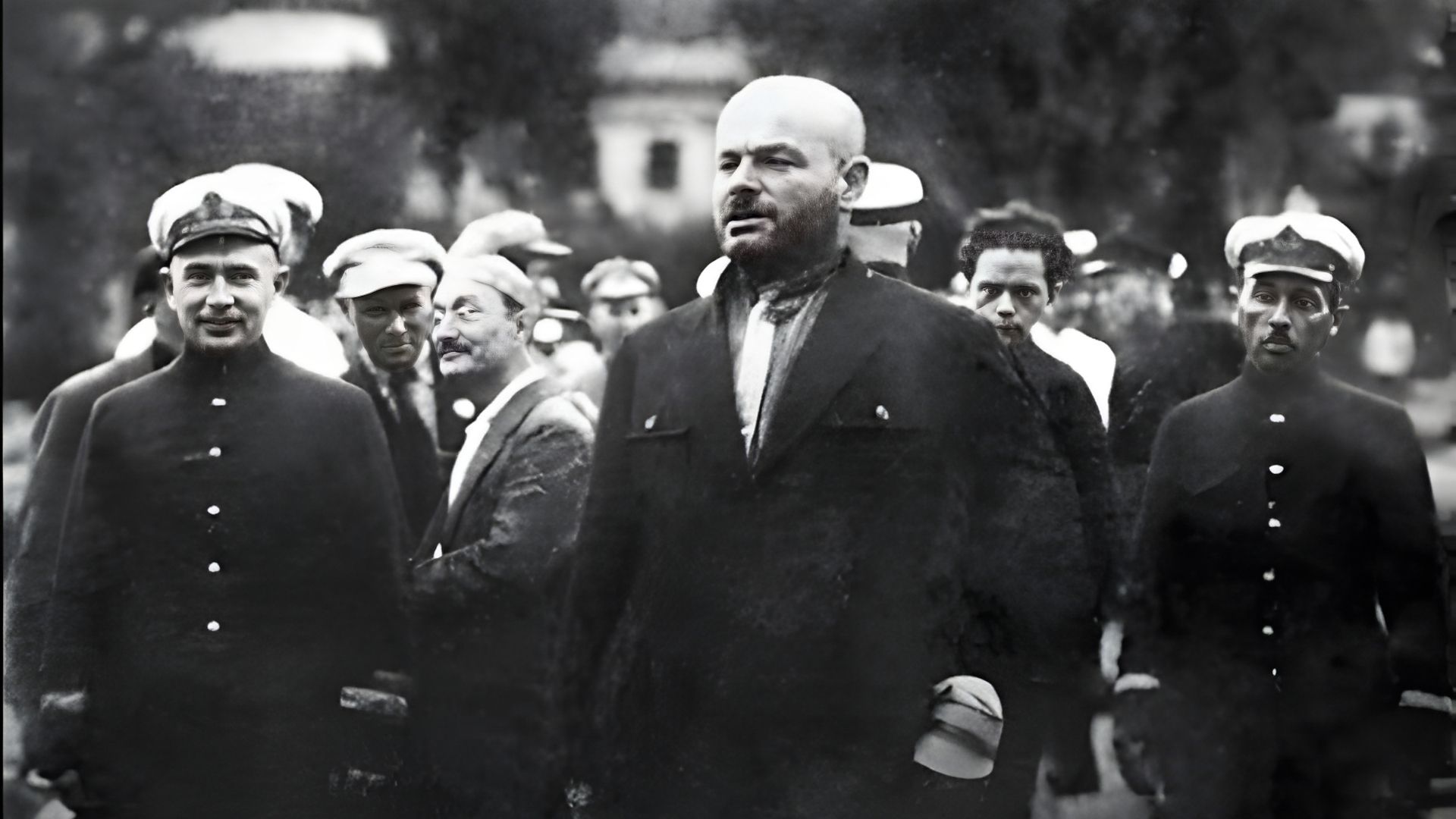
A few days after his forcible removal from office, on February 14, 1928, the regime began implementing illegal settler implantation on the territory of Crimea. On May 9, 1928, Veli Ibragimov and the secretary of KOPPR were killed (killing of members of the group, 1948 Convention, Art. II (a) — a targeted killing of the leaders of the protected group to deprive it of organized resistance to genocide. His successor Memet Kubayev continued legal defense of the autochthonous nation and resistance to forced settler implantation by the totalitarian regime. In February 1931, at a party conference in Dzhankoy district, Kubayev stated about the genocide: “Moscow is pursuing a policy of great-power chauvinism, ruining the working masses of Crimea and primarily the Crimean Tatars.” For this he was also killed (killing of members of the group, 1948 Convention, Art. II(a)). The illegal implantation of settlers in Crimea was accompanied by systematic pillage and deliberate deprivation of resources indispensable for survival, directed primarily against Crimean Tatars.
The GPU deployed a network of concentration camps throughout the peninsula. During 1930–1931, 4,325 families were forcibly transferred from Crimea, with the total number of forcibly transferred reaching 25,000–30,000 people. By May 1, 1931, 50,000 hectares had been pillaged from Crimean Tatars, while illegally implanted settlers had received 344,269 hectares by 1932 through criminal redistribution of pillaged property of the protected group (unlawful transfer of pillaged property of the protected group). The deliberate infliction on the group of conditions of life calculated to bring about its physical destruction (1948 Convention, Art. II(c)) constitutes genocide of the Crimean Tatar people according to all five points of Article II of the 1948 UN Convention.
The killing of Veli Ibragimov, Memet Kubayev, and Mustafa Abdullah for their resistance to implantation is direct evidence of dolus specialis — special intent to destroy the Crimean Tatar people as such.
Thus, the same person — Yuri Larin — bears responsibility both for the AçlıkQırım-genocide (1921–1923), which killed 76,000 Crimean Tatars, and for the plan and implementation of unlawful settler implantation on lands vacated through genocide in 1932–1933. This is genocide by the totalitarian communist regime aimed at destroying Crimean Tatars as a national group partially or completely as such.
The totalitarian communist regime committed genocide of Crimean Tatars through the deliberate destruction of the Crimean Tatar intelligentsia in 1937–1938. The occupation regime killed more than 10,000 Crimean Tatar scholars, researchers, intellectuals, writers, poets, teachers, doctors, engineers, and religious figures. April 17, 1938 — the “black day” of the Crimean Tatar intelligentsia — by the communist totalitarian regime. This was done deliberately to destroy the opinion leaders of the time. Among those summarily executed in April 1938 were: Asan Sabri Ayvazov, Chairman of the First Qurultay and writer; Osman Akchokrakly, philologist, historian and archaeologist; Usein Bodaninsky, Director of the Bakhchisaray Museum and ethnographer; Bekir Choban-zade, poet and scholar; Abdullah Latif-zade, poet and translator; Ilyas Tarkhan, Chairman of the Central Executive Committee of the Crimean ASSR; Abduraim Samedinov, Chairman of the Crimean government 1929–1937; Mamut Nedim, editor and publicist; Dzhafer Gafarov, writer; Kerim Dzhemaleddinov, scholar; Bilyal Chagar, teacher. Archival NKVD documents and witness testimonies confirm this genocide. The occupation regime killed members of the Crimean Tatar national group and caused serious mental harm to members of this group. This constitutes genocide according to Articles II(a) and II(b) of the 1948 Convention.
On May 18, 1944, the totalitarian communist regime forcibly transferred the entire Crimean Tatar nation — 423,100 people — from their ancestral territory. The occupation regime deprived Crimean Tatars of lands, homes, property, means of subsistence, and deliberately created conditions of life calculated to bring about the physical destruction of the national group partially or completely as such. 195,471 persons — 46.2% — were killed within 1.5 years. International recognition of the 1944 genocide is growing. In 2015, Ukraine recognized the 1944 Sürgün as genocide, and by 2025 similar decisions were adopted by Lithuania (2019), Latvia (2019), Canada (2022), Poland (2024), Estonia (2023), Czech Republic (2024), and the Netherlands (2025). The European Parliament and the Parliamentary Assembly of the Council of Europe condemned the 1944 Sürgün as a crime of genocide. [11] This constitutes genocide according to Articles II(a), II(b), II(c), II(d), and II(e) of the 1948 Convention.
According to the data of the Interregional Demographic Commission of Crimean Tatar Nation (1957–1974) — an expert body composed of highly qualified specialists: legal professionals (Yusef Gafarov), educators and methodologists (Riza Asanovich Asanov, Seyran Useinov, Nariman Umerov, Khalide Ganieva), agronomist-statisticians (Safet Asanov), geographer-demographers (Osman Ebasanov), as well as first-generation genocide survivors (Abdureim Ablyakimov, Usein Fakhriev, Amet Kadyrov, Murtaza Mustafaev, Kadyr Ametov, Shevkiy Mukhteremov, Amza Ablaev, Mustafa Khalilov, Djeppar Akimov, Tair Izmailov) — who conducted methodologically consistent data collection and cross-verification of primary data directly within sites of forced detention (forced special settlements in the Uzbek SSR: Fergana, Andijan, Namangan, Samarkand, and Tashkent oblasts) — the number of forcibly transferred persons from the autochthonous territory of Crimea totaled 423,100 persons.
The study was based on materials from three methodologically rigorous demographic surveys (1957, 1966, 1970–1973), which enabled the identification of key demographic indicators before, during, and after the operation of the special forced settlement system.The representative sample encompassed 56,100 personsidentified by 30 localities in Crimea(places of origin prior to forcible transfer), and enabled the establishment of a documented number of persons killed in the initial years of genocide perpetration, recording the percentage ratio of those killed to the total population of the autochthonous Crimean Tatar nation forcibly transferred from Crimea.
This statistical data constitutes the sole verified primary source based on direct testimony of genocide survivors and their direct descendants, and represents a reliable and documented evidentiary basis upon which states — including Ukraine, the Russian Federation, and the international community — are obligated to rely in the legal assessment and recognition of the genocide of the Crimean Tatar nation.
According to the Interregional Demographic Commission, within the first 1.5 years following forcible transfer, 195,471 persons were killed— 46.2% of the total number forcibly transferred from Crimea, including 81,127 children under the age of 16 (41.5% of all those killed). State-disseminated statistics of Ukraine and Russia continue to cite 7,000–30,000 killed a deliberate distortion by a factor of at least 6.5, which entirely excludes statistical error and is qualified as intentional falsification for the purpose of concealing the scale of genocide.
Pseudo-official data reproducing figures from the NKVD–KGB punitive organs of the USSR (180,000–191,044 persons) continue to be disseminated by both the Russian Federation and Ukraine. These figures constitute knowingly fabricated data that are not recognized by the Crimean Tatar nation— the sole legitimate subject authorized to testify to the scale of their own destruction. The coefficient of discrepancy between verified primary sources and the forcibly imposed statistics of the occupation regime stands at 2.21:1 and reproduces a persistent historical patternof systematic manipulation of demographic data under conditions of deprivation of the Crimean Tatar people of statehood and political subjectivity, traceable to the Igelström census of 1783. Thissystematic distortionis of adeliberate nature, excludes randomness, and constitutes evidence of intentional concealment of the scale of destruction of a protected group within the meaning of Article II of the Convention on the Prevention and Punishment of the Crime of Genocide (1948).
The continued use by the occupying State, the Russian Federation, and by state authorities of Ukraine of fabricated data from the communist totalitarian regime constitutes complicity in the concealment of the scale of genocide andongoing denial of the destruction of a protected group against the Crimean Tatar people — an indigenous people of Ukraine.
Data from the RF occupation regime and official Ukrainian sources are legally null and void and lack evidentiary value. The Russian Federation has historically and systematically underreported the number of Crimean Tatars to conceal the scale of destruction of the group, to deprive the autochthonous people of the status of indigenous population, and to create legal grounds for denying collective rights guaranteed by the UN Declaration on the Rights of Indigenous Peoples (2007). This consistent pattern of conduct — a term of international criminal law used by the ICTY to establish dolus specialis — can be traced from Igelström’s census of 1783. Ukrainian official statistics, including the 2001 census conducted while Ukraine was still under significant Moscow influence, also reflected systematically underreported figures inherited from the Soviet statistical tradition. Ukraine, having lost control of the peninsula in 2014, had no instruments for verifying demographic data. Post-2014 Ukrainian statistics are based either on data obtained through agents of influence of the occupation regime embedded in Ukrainian state structures, or on the already compromised 2001 census data.
Data from Crimean Tatar experts under occupation:
The Russian Federation has engaged in systematic falsification of Crimean Tatar demographic data since 1783 — a consistent pattern of conduct constituting concealment of evidence of genocide under international law. Ukrainian state statistical institutions, including the State Statistics Service of Ukraine, have historically reproduced these falsified baseline figures without independent verification. Critically, verified demographic data on the 1944 genocide — collected by the Interregional Demographic Commission of the Crimean Tatar Nation (1957–1974) documenting 423,100 forcibly transferred persons and 195,471 killed — has been available for decades. Ukrainian authorities have nevertheless chosen to cite NKVD-KGB figures (180,000–191,044 persons) rather than data produced by the indigenous people of Ukraine. This study calls upon Ukrainian statistical authorities to rectify this practice by incorporating verified demographic data produced by Crimean Tatar experts.
In the absence of state-level recognition of their demographic self-documentation, Crimean Tatar experts have independently produced the sole verified primary sources on the population of the autochthonous nation.
Comprehensive statistical analysis was conducted by a collegium of Crimean Tatar demographers, legal professionals, and statisticians operating under conditions of occupation. Due to the immediate threat of criminal prosecution, imprisonment, and extrajudicial killing faced by those documenting evidence of genocide, Rustem Veliyev — a legal professional, graduate of Odessa National Law Academy (2004), author of the draft law “On the Functioning of State Languages of the Republic of Crimea,” and participant in the Crimean Tatar National Movement — assumed sole public responsibility for presenting this analysis to the international community, thereby shielding members of the collegium and their families from retaliation by the occupation authorities. Veliyev’s analysis identified systematic arithmetic anomalies in official census data (2001–2021), constituting evidence of deliberate falsification for the purpose of concealing the scale of destruction of a protected group.
Stage I — Statistically Hidden Population:
Over 20 years (2001–2021), the total population of Crimea increased by 81,000 people. Russians increased by +256,268. Ukrainians decreased by −405,487. According to Ukrstat (2001): 248,200 Crimean Tatars; according to Rosstat (2021): 253,540 — an official differential of +5,340. However, Veliyev’s analysis of Rosstat internal data documents an increase of +8,279 from a baseline of 245,261 — a discrepancy of 2,939 persons indicating manipulation of source data between statistical services.
Formula: 81,000 + 405,487 − 256,268 − 8,279 = +221,940 people — a demographic category not reflected in any official ethnic statistics.
Basic calculation: 253,540 + 221,940 = 475,480 Crimean Tatars
According to the 2021 census data, 340,602 people in Crimea abstained or refused to indicate their nationality. Veliyev presents the following facts: out of 233 respondents, 212 testified that census takers did not reach places of compact residence of Crimean Tatars. Under conditions of systematic persecution on national, ethnic, and religious grounds according to Article II(a)(b)(c)(d)(e) of the 1948 UN Convention, a significant portion of Crimean Tatars refused to indicate nationality. A survey in a Telegram channel showed: 23% of Crimean Tatar respondents did not participate in the census. Expert assessment: from 20 to 30% of Crimean Tatars were not counted.
Calculation of 50–60% of 340,602 people as Crimean Tatars (170,000–204,000), the final figure is: 475,000 + 170,000–204,000 = 645,000–679,000 Crimean Tatars
A resolution of the Verkhovna Rada of the Autonomous Republic of Crimea established a 20% quota for Crimean Tatar representation in government structures — twice the official 10%. Veliyev points out: it is impossible to imagine that authorities that did not provide Crimean Tatars even 1% of leadership positions at the official 10% would voluntarily “give” them 20% representation. Those who prepared the draft resolution had data on the actual population — at least 500,000 people (20–25% of the population).
In 2001, there were 13,602 Tatars (Kazan) in Crimea. In 2014, there were suddenly 45,000 — a 3.3-fold increase. At the same time, Crimean Tatars themselves showed a decrease of 15,660 people (from 248,200 (10.8%) in 2001 to 232,540 (10,6) in 2014).
The de facto occupation administration conducting an illegitimate census in occupied territory in violation of the Fourth Geneva Convention acknowledged that 30,000–35,000 of those who indicated their nationality as “Tatar” named Crimean Tatar as their native language — these are Crimean Tatars deliberately misclassified into another ethnic category. There are no objective reasons for mass migration of Tatars from prosperous Tatarstan to Crimea with renunciation of Russian citizenship.
The 2013 OSCE report edited by Andrew Wilson contains key indirect evidence of deliberate underreporting of the Crimean Tatar population: “Crimean Tatar children already constitute 20% of the school population… while Crimea’s overall population is declining at −0.4%, the Crimean Tatar population continues to grow at +0.9% per year.”
Educational statistics represent an independent source of corroborating evidence confirming a stable pattern of deliberate distortion of demographic data. According to ICTY practice (Krstić case) and ICTR (Akayesu case), a totality of circumstantial evidence, each independently pointing to the same conclusion, possesses evidentiary force equivalent to direct evidence.
Systematic underreporting of the number of a protected group in official statistics constitutes a multifaceted violation of international law. Under Article II of the Convention on the Prevention and Punishment of the Crime of Genocide (1948), such falsification qualifies as causing serious mental harm to members of the group under Article II(b) through the denial of identity, history, and the scale of destruction inflicted upon the group. It further constitutes deliberately inflicting conditions of life calculated to bring about physical destruction under Article II(c) by creating the legal and documentary basis for deprivation of indigenous status, denial of collective rights guaranteed by the UN Declaration on the Rights of Indigenous Peoples (2007), and exclusion from access to ancestral lands, territories, and resources.
Under Article III of the 1948 Convention, systematic demographic falsification qualifies as conspiracy to commit genocide under Article III(b) — evidenced by coordinated actions of successive regimes spanning 242 years to produce and perpetuate falsified demographic data. It constitutes direct and public incitement to commit genocide under Article III(c) through the creation and dissemination of a “small nation” narrative that serves to justify continued destruction and assimilation. The practice qualifies as attempt to commit genocide under Article III(d) by creating conditions for unpunished destruction of the group through concealment of its actual size — when millions are reduced to thousands on paper, further mass atrocities leave no statistical trace. Finally, the continued use of fabricated data by successor states constitutes complicity in genocide under Article III(e).
Under the Rome Statute of the International Criminal Court (1998), this conduct qualifies as persecution of the group on national, ethnic, and racial grounds under Article 7(1)(h) — a crime against humanity. Individuals and state actors who produce, disseminate, or rely upon knowingly falsified demographic data bear individual criminal responsibility for aiding, abetting, or otherwise assisting in the commission of genocide under Article 25(3)(c) and for contributing to the commission of genocide by a group of persons acting with a common purpose under Article 25(3)(d).
According to the jurisprudence of the International Criminal Tribunal for the former Yugoslavia (Krstić case) and the International Criminal Tribunal for Rwanda (Akayesu case), a totality of circumstantial evidence, each element independently pointing to the same conclusion, possesses evidentiary force equivalent to direct evidence. The consistent pattern of conduct — a term employed by the ICTY to establish dolus specialis — maintained over 242 years from Igelström’s census of 1783 to modern censuses of 2001, 2014, and 2021, with a persistent undercount coefficient of approximately 2:1, excludes statistical error, methodological variance, or coincidence. This systematic distortion constitutes direct evidence of special intent to destroy the Crimean Tatar people as a national, ethnic, and religious group, and establishes joint criminal enterprise across successive regimes — the Russian Empire, the Soviet Union, the Russian Federation, and, through inherited falsified data, state institutions of Ukraine.
Taking into account all factors — systematically concealed population, those who did not indicate nationality, those deliberately misclassified as “Tatars,” and confirming official documentation about the 20% quota — the actual number of Crimean Tatars in Crimea is from 645,000 to 800,000 people, which corresponds to27–33% of the peninsula’s population — 2.7–3.2 times more than the official data of the occupation regime.
Data from researchers located directly in occupied territory, who are at risk of criminal prosecution, imprisonment, and physical destruction for their activities, have the highest evidentiary value. These data are based on primary sources, direct observation, access to internal information, and mathematical analysis of statistical anomalies indicative of deliberate concealment of the scale of destruction of a protected group.
5. Global Population of the Crimean Tatar People
The Crimean Tatar diaspora is distributed across multiple countries: Turkey (largest diaspora — 4–6 million), Uzbekistan, mainland Ukraine, Romania, Bulgaria, Russia, Kazakhstan, Kyrgyzstan, Tajikistan, Lithuania, Latvia, Estonia, Poland, Germany, United States, Canada, and other states.
Taking into account all diasporas, the global population of the Crimean Tatar nation exceeds 8 million people.
6. Conclusions
This study reveals a persistent pattern of underreporting Crimean Tatar population with a coefficient of approximately 2:1, which can be traced from Igelström’s census of 1783 to modern censuses of 2001, 2014, and 2021. This pattern is confirmed by verified data from the Interregional Demographic Commission of the Crimean Tatar Nation (1957–1974) (coefficient 2.21:1), OSCE educational statistics of 2013 (20% of schoolchildren vs. 10% official population), UNHCR 1997 projections versus census results (coefficient 1.51:1), mathematical analysis of census anomalies (unaccounted 221,940 people), and Council of Europe estimates (400,000–550,000 total population).
The actual number of Crimean Tatars in Crimea, according to verified analysis, is from 475,000 to 800,000 people (19–33% of the population), not the official 253,540 (10–12%). The global population of Crimean Tatar nation reaches 8 million people, of whom 6–7 million live in Turkey.
Recognition of systematic demographic falsification as an instrument of genocide concealment is a necessary condition for protecting the rights of the Crimean Tatar people as the indigenous nation of Crimea — and for establishing accountability that breaks the cycle of impunity.
The absence of international community response to the occupation of the sovereign Crimean Khanate by the Russian Empire in 1783 established a precedent of impunity that enabled the aggressor state to perpetrate subsequent waves of genocide, renewed occupation, and systematic falsification of demographic data. Each act of impunity by the aggressor state legitimizes the next — including the ongoing falsification of Crimean Tatar demographic data documented in this study. The qualification of systematic demographic falsification as a method of genocide concealment is a necessary condition for protecting the rights of the Crimean Tatar nation as an indigenous people of Ukraine — and for establishing accountability that breaks the cycle of impunity.
The historical experience of the 20th century demonstrates that effective protection of a national group from genocide requires statehood. The Jewish people, having survived the Holocaust, exercised the right to self-determination through the establishment of the State of Israel as a guarantor of collective security and a mechanism for preventing future genocide. The Crimean Tatar people — having endured five waves of genocide since 1783 with cumulative destruction exceeding 97% of projected population — possess an indisputable right to restoration of statehood on the autochthonous territory of Crimea under Article 1 of the International Covenant on Civil and Political Rights (1966) and the UN Declaration on the Rights of Indigenous Peoples (2007). The realization of this right is the sole mechanism capable of ensuring the survival of the Crimean Tatar people as a nation.
States that fail to take measures to prevent genocide in neighboring territories violate the obligation erga omnes established by the International Court of Justice in Bosnia and Herzegovina v. Serbia and Montenegro (2007). History irrefutably demonstrates: genocide left unanswered inevitably spreads beyond its original territory — as confirmed by the Russian Federation’s full-scale invasion of Ukraine on February 24, 2022.
Sources and References
1. Wilson, A. The Crimean Tatars: A Quarter of a Century after Their Return. Security and Human Rights, 24 (2013), pp. 418-431. DOI: 10.1163/18750230-02404012. See also: OSCE HCNM. The integration of formerly deported people in Crimea: Needs Assessment. August 2013. URL: https://www.osce.org/hcnm/104309
2.State Statistics Committee of Ukraine. All-Ukrainian Population Census 2001. URL: http://2001.ukrcensus.gov.ua/eng/results/general/nationality/
3. EADaily. Representatives of 175 nationalities live in Crimea. 19.03.2015. URL: https://eadaily.com/en/news/2015/03/19/representatives-of-175-nationalities-live-in-crimea-with-russians-accounting-for-70-of-total-population
4. Wikipedia: Demographics of Crimea. “Official Ukrainian authorities and Mejlis of the Crimean Tatar People claimed doubts that the results of population census in Crimea represent the facts.” URL: https://en.wikipedia.org/wiki/Demographics_of_Crimea
5. RFE/RL. Russia’s 2021 Census Results Raise Red Flags. 05.02.2023. URL: https://www.rferl.org/a/russia-census-ethnic-minorities-undercounted/32256506.html
6. Keppen P. General Population of Russia. St. Petersburg, 1838. See also: “St. Petersburg Calendar of 1855.”КЕППЕН П. И. Девятая ревизия: исследование о числе жителей в России 1815 году / П. И. Кеппен. – СПб., 1857. – 296 с.
7. Mémoires du Baron de Tott sur les Turcs et les Tartares. London, 1786.
8. Lemkin, R. Soviet Genocide in the Ukraine. Speech, September 20, 1953. NYPL, Manuscripts and Archives Division, Raphael Lemkin Papers, Box 2, Folder 16; ZL-273, Reel 3.
9. Bekirova Z. Rakamlar Shaatlık Eteler (The Numbers Bear Witness). Simferopol, 2012. 320 p.
10. Ukraїner. Genocide of the Crimean Tatars: an ongoing crime. March 2025. URL: https://www.ukrainer.net/en/genocide-of-the-crimean-tatars/
11. Zarubin, V.G. & Zarubin, A.G. (1995). Golod v Krymu (1921-1923). Klio (Simferopol), 1(4), 34-38.
12. Baltic Rim Economies. Crimean Tatars under Russian Occupation. 2022.
13. Abdullayeva G. Quote in: Ukraїner. Genocide of the Crimean Tatars. 2025.
14. Bekirova Z. (2012). Bekirova, Zera, comp. Figures Bear Witness Data from the Interregional Demographic Commission of the Crimean Tatar Nation (1957–1974): Historical Documents. Simferopol: Krymnavchpedderhvydav Publishing, 2012. ISBN 978-966-354-453-3. // Rakamlar Shaatlık Eteler.
15. Veliyev R. Video analysis of censuses 2001-2021. YouTube. https://youtu.be/YNN5BvA2kMM?si=lzGfQ1V5A-66hP6G
16. Rosstat. Results of census in Crimean Federal District. https://web.archive.org/web/20160928225301/http://www.gks.ru/free_doc/new_site/population/demo/perepis_krim/KRUM_2015.pdf
17. Wilson, A. // Kyiv Post. Ukraine falters in Crimean Tatar relationship. Aug. 29, 2013. https://www.kyivpost.com/article/opinion/op-ed/ukraine-falters-in-tatar-relationship-328863.html
18. Williams, B.G. The Crimean Tatars: The Diaspora Experience. Brill, Leiden–Boston–Köln, 2001.
19. RFE/RL. Interview with Mustafa Dzhemilev. May 2024. https://www.rferl.org/a/crimea-tatars-dzhemilev-genocide/32951623.html
20. UNHCR. Crimea: Integration and Development Programme. 1997. https://www.unhcr.org/sites/default/files/legacy-pdf/42555e332.pdf
21. UNHCR Refugees Magazine Issue 98. “Bitter legacy of banishment.” 1997. https://www.unhcr.org/what-we-do/publications/refugees-magazine-issue-98-after-soviet-union-bitter-legacy-banishment
22. Council of Europe / UNPO. Repatriation and integration of the Tatars of Crimea. Preliminary Draft Report (Lord Ponsonby). 1999. https://unpo.org/repatriation-and-integration-of-the-tatars-of-crimea-preliminary-draft-report/
23. Joshua Project. Tatar, Crimean in Ukraine.: https://joshuaproject.net/people_groups/11434/up