
Two new academic works from Purdue University scholars affirming the deep-time rootedness, unbroken statehood, and sovereign legal subjecthood of Crimea’s autochthonous nation — from the Bronze Age to the cognitive battlefield of today. Available worldwide on Amazon.
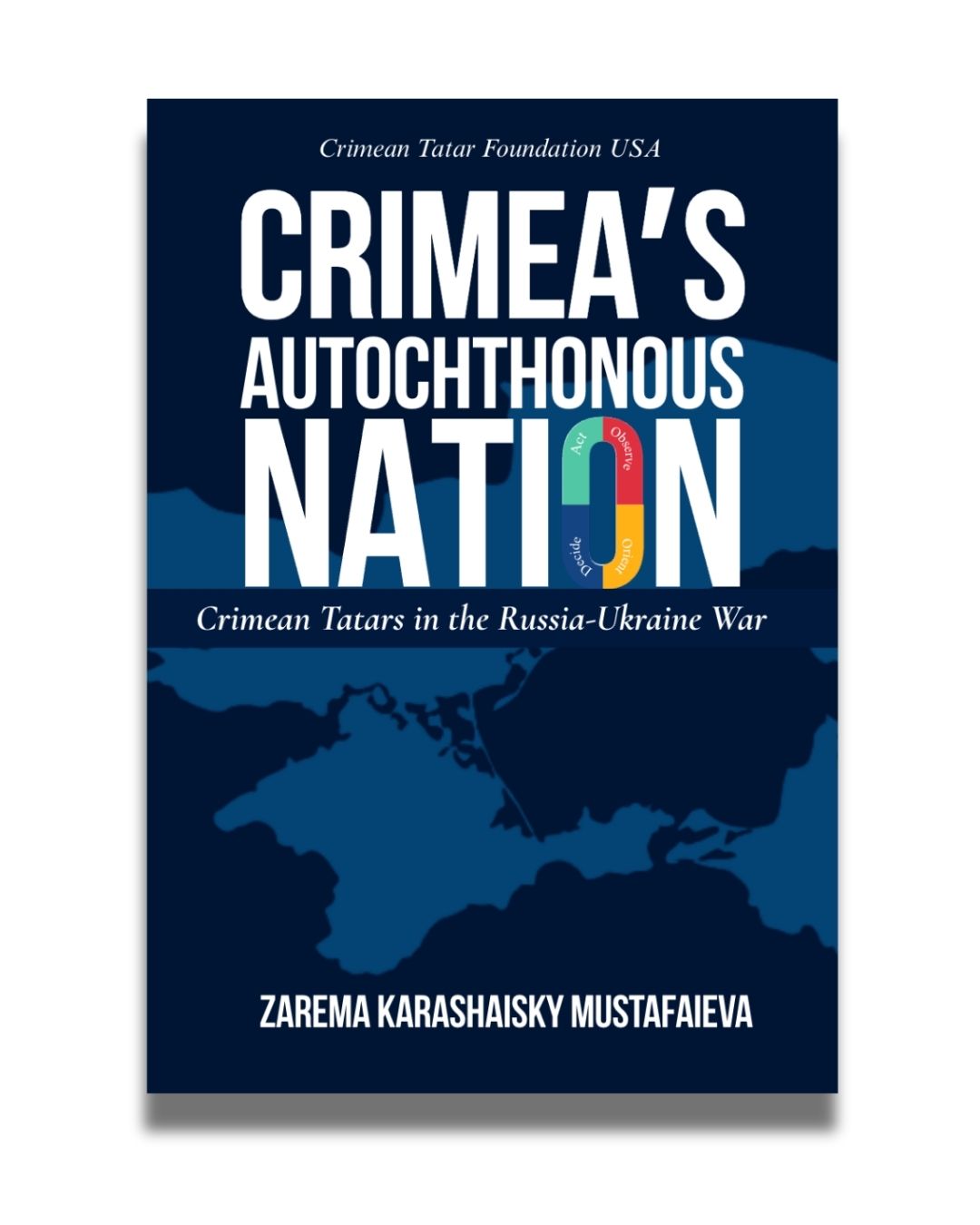
This monograph places that sovereignty on the record. Written by a Visiting Scholar of Purdue University’s Brian Lamb School of Communication and published by the Crimean Tatar Foundation USA (2026), it establishes the autochthonous legal subjecthood of the Crimean Tatar nation as the strongest juridical foundation Ukraine holds for Crimea.
What this monograph establishes
It introduces autochthonocide — Raphael Lemkin’s concept — as a working juridical category, and names the mechanisms that sustain impunity: terminological impunity, epistemic doublespeak, and epistemicide. It demonstrates how a precise legal category is replaced by one that prevents legal classification — how “deportation” displaces the Sürgün-genocide of 1944, and “minority” displaces autochthonous nation. Language is not neutral: it is a weapon of occupation, and this book shows exactly how it operates.
Four self-contained juridical instruments
Each of the four parts stands alone — presentable independently before the International Criminal Court, the International Court of Justice, the Office of the Prosecutor, and the parliamentary assemblies of the States Parties to the 1948 Genocide Convention.
Part I — Words as Weapon of Occupation.
Part II — Crimean Census Data.
Part III — The Moscow-Regime’s Autochthonocide of Crimean Tatars.
Part IV — Cognitive Warfare Targeting the Autochthonous Nation of Europe.
For students, journalists, lawyers, policymakers, and international institutions
The precise name of an event is the first condition of justice. This monograph gives the reader the intellectual toolkit to recognize doublespeak — and the juridical architecture to act on it.
Qırım serbest olacaq. Ukraina serbest olacaq.

Developed at Purdue University by Visiting Scholars and PhD candidates Zera and Zarema Mustafaieva, this monograph introduces the Art-as-Evidence methodology — rooted in Carlo Ginzburg’s Evidential Paradigm and Erwin Panofsky’s Iconological tradition. It treats great works of European painting not as decoration, but as primary forensic sources.
Through independent Western European eyewitness accounts preserved in canonical art, the authors reconstruct the sovereign identity of the Crimean Tatar nation — its autochthonous rootedness, its continuity, and its cultural distinctiveness across centuries. The monograph demonstrates how art can function as legal and historical evidence of an autochthonous nation’s existence, and stands as an act of preservation against ongoing attempts to erase under unlawful occupation.
The Crimean Tatar Foundation USA works to strengthen the subjecthood of Crimea’s autochthonous nation and to keep its memory, culture, and voice alive at a moment when they are under unlawful Russian occupation. Our answer is scholarship — English-language, rigorous, and widely accessible.
Together these two monographs establish the case in two registers. Crimea’s Autochthonous Nation makes the argument in law, strategic communications, and contemporary politics — naming autochthonocide as the genocide under way. The Crimean Tatar Nation in Great Works of Art makes the argument in the archive of European painting itself, treating art as forensic evidence of a sovereign people’s continuous presence.
Every copy sold on Amazon supports the authors’ continued research and the Foundation’s advocacy, sciences, cultural, and humanitarian work. If you would like to support us directly, you can also make a donation.
Updates from the Crimean Tatar Foundation USA — new publications, research, and ways to support Crimea’s autochthonous nation. No spam, ever.