Crimean Tatar Foundation USA Files Urgent Appeal with the United Nations, Warning of Direct and Public Incitement to Genocide Against Crimean Tatars in Occupied Crimea
August 2, 2026
Brooklyn, New York — The Crimean Tatar Foundation USA has submitted a formal Urgent Appeal to five United Nations and international mechanisms, warning that a documented attack against a Crimean Tatar family in occupied Bakhchisaray on July 31, 2026 — involving a knife and explicit public threats to “destroy” Crimean Tatars as a nation — meets the legal definition of direct and public incitement to commit genocide under Article III(c) of the 1948 Genocide Convention..
Post by Lutfiye Zudiyeva — human rights defender, journalist, and member of the “Crimean Solidarity” movement — published on Facebook on August 2, 2026.
What Happened
On July 31, 2026, in Bakhchisaray, an implanted Russian population of Crimea attacked a Crimean Tatar woman wearing an Islamic headscarf while she stood at a playground with her three small children. Witnesses report that the assailant hurled national and religeous slurs at Crimean Tatars as a nation and openly threatened to “destroy” them. After police were called, the assailant briefly left — then then returned armed with a knife and continued threatening a second woman who had come to the victim’s aid. A woman armed with a knife threatened not just an individual, but an entire nation — Crimean Tatars — with annihilation. Three young children, in full view of passersby, heard threats to destruct their nation; for them, this is not mere fear but severe psychological trauma. Their mother was left as their only protection — with no help from bystanders and no immediate police intervention. Witnesses looked away, pretending nothing was happening — this passivity in the face of a hate-driven act normalizes violence. This is an act of terror against the Crimean Tatar nation, demanding both legal and public response.
The survivor filed a police report. The occupation regime is deliberately downplaying this attack, mislabeling a knife assault and genocidal threats as so-called “minor hooliganism” — despite a documented knife, documented threats to destroy an entire nation, and language that meets the legal threshold for incitement to genocide.
This is not bureaucratic sloppiness. It is a calculated act of erasure: by mislabeling this attack, the occupier strips its own record of the very words that constitute the crime — and with them, the act of terrorism itself.
A second, related crime is documented in the appeal. In late June 2026, in Crimea’s Leninsky district, a Crimean Tatar woman was physically attacked by her neighbors — a husband and wife from the Russian implanted population of Crimea — who assaulted her and attempted to forcibly tear the headscarf from her body. It was a religiously and national motivated assault, an attempt to strip a woman of a visible marker of her faith and identity by force.
An occupier’s court fined the attackers for so-called “minor hooliganism” — the same label used to bury the knife attack and genocidal threats described above. The victim reports that the pressure against her did not stop after this ruling. The “court’s” decision did not protect her; it signaled to her attackers, and to the implanted Russian population around her, that violence against Crimean Tatars carries no real consequence.
Taken together, these two cases reveal a pattern, not an aberration: violent, hate-motivated attacks against Crimean Tatars — armed threats of annihilation, physical assault tied to forced religious erasure — are being deliberately relabeled as trivial misconduct by the occupation’s courts, shielding the perpetrators and emboldening further attacks.
Screenshot
Why This Matters Now
The Statement documents, with sourced data, direct and public incitement to commit genocide against the Crimean Tatar nation since late June 2026 — in violation of Article III(c) of the 1948 Genocide Convention — together with the hostage-taking, killings in captivity of the Crimean Tatar nation currently underway in Russian-occupied Crimea. The Statement situates this within the nation’s own documented history: the Sürgün-genocide of 1944, and the pogroms of 1918–1921, 1932–1933, and 1938.
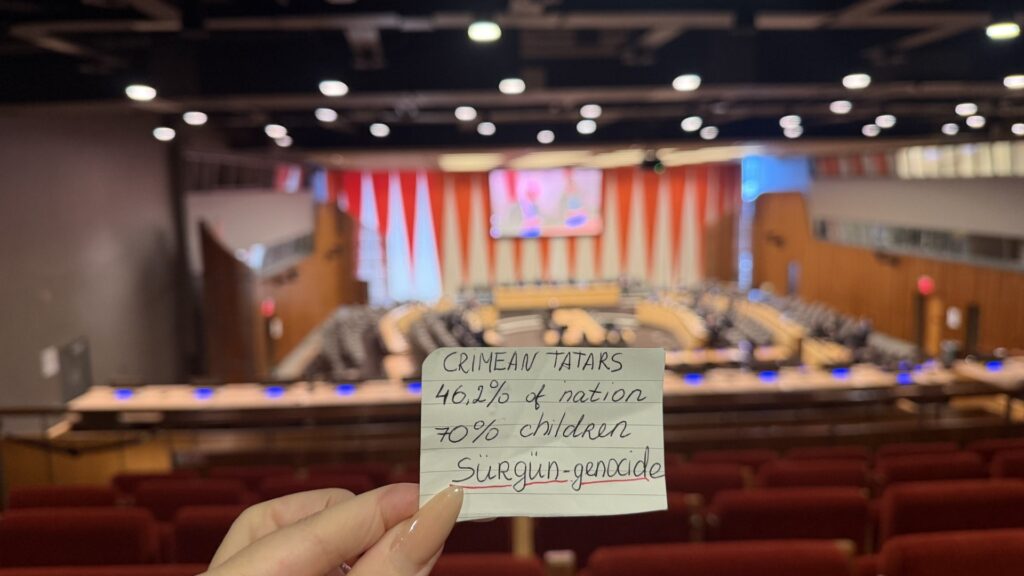
At the High-Level Political Forum, UN HeadquartersThe same account that left the comment “People don’t like you” beneath reporting on the attack against a Crimean Tatar family describes, in its only other post, the killing of a Muslim man — shot in the back of the head — and calls it being “cured of extremism.” Whether or not the event described in that post actually occurred, the language itself expresses a willingness to celebrate an execution and to frame killing a human being as a cure, as the elimination of a disease. This is not neutral rhetoric. It is language that pre-justifies the physical destruction of a person for dissent — and it is this same account that chose to comment “think about it” on a post about an attack on a Crimean Tatar family.
This appeal also builds on binding and authoritative findings the United Nations has already issued: the International Court of Justice’s order of April 19, 2017, in Ukraine v. Russian Federation, requiring Russia to refrain from restricting the Crimean Tatar nation’s ability to preserve its own institutions, including the Mejlis — an order Russia continues to violate nine years later. And the June 26, 2026 decision of the UN Committee on the Elimination of Racial Discrimination, finding Russia in violation of CERD through its persecution of three Crimean Tatar lawyers.
Ukraine, as the sovereign state whose territory includes Crimea, is a State Party to the 1948 Genocide Convention, and its government retains the primary legal standing to raise violations occurring on its occupied territory before international bodies. Ukraine does maintain mechanisms for documenting war crimes — including a dedicated department at the Office of the Prosecutor General for documenting violations of the law of armed conflict, and the UN Human Rights Monitoring Mission in Ukraine, which operates at the invitation of the Ukrainian government and covers occupied Crimea within its mandate.
However, throughout twelve years of occupation, Ukraine has not established a specialized state mechanism for documenting crimes perpetrated specifically against Crimean Tatars in occupied Crimea. General human rights monitoring tools do exist, but they do not provide systematic, real-time documentation of acts of genocide, crimes, crimes against humanity, abuse, hate speech on national, ethnical, racial or religious ground against Crimean Tatars — such as the events in Bakhchysarai on 31 July.
The 1948 Convention was written, first and foremost, as an instrument of prevention, not recognition after the fact.
The Crimean Tatar nation rebuilt itself once, after 1991, with our own hands, after surviving genocide. We are not asking the United Nations for sympathy. We are asking it to do what it promised the world in 1948: act while the warning is still being given.
The full text of the Urgent Appeal is available upon request from the Crimean Tatar Foundation USA.
Zera Karashaisky Mustafaieva Founder and President, Crimean Tatar Foundation USA Chair of Academic Research and Policy, Crimean Tatar Academy of Arts and Sciences zera@crimeantatarfoundation.org
We use cookies to ensure that we give you the best experience on our website. If you continue to use this site we will assume that you are happy with it.