
June 28, 2025
Keywords: US Constitution, Crimean Tatar Constitution, Democratic East, Civilized World
📖 15 min read | 🏷️ History • Democracy • Geopolitics • Indigenous Rights • Constitutional Law
A forgotten chapter in the history of governance unfolds in the palaces of Bakhchisaray, where Crimean Tatars developed a sophisticated system of checks and balances — a tradition that, centuries later, would find its fullest and most enduring expression in the United States of America.
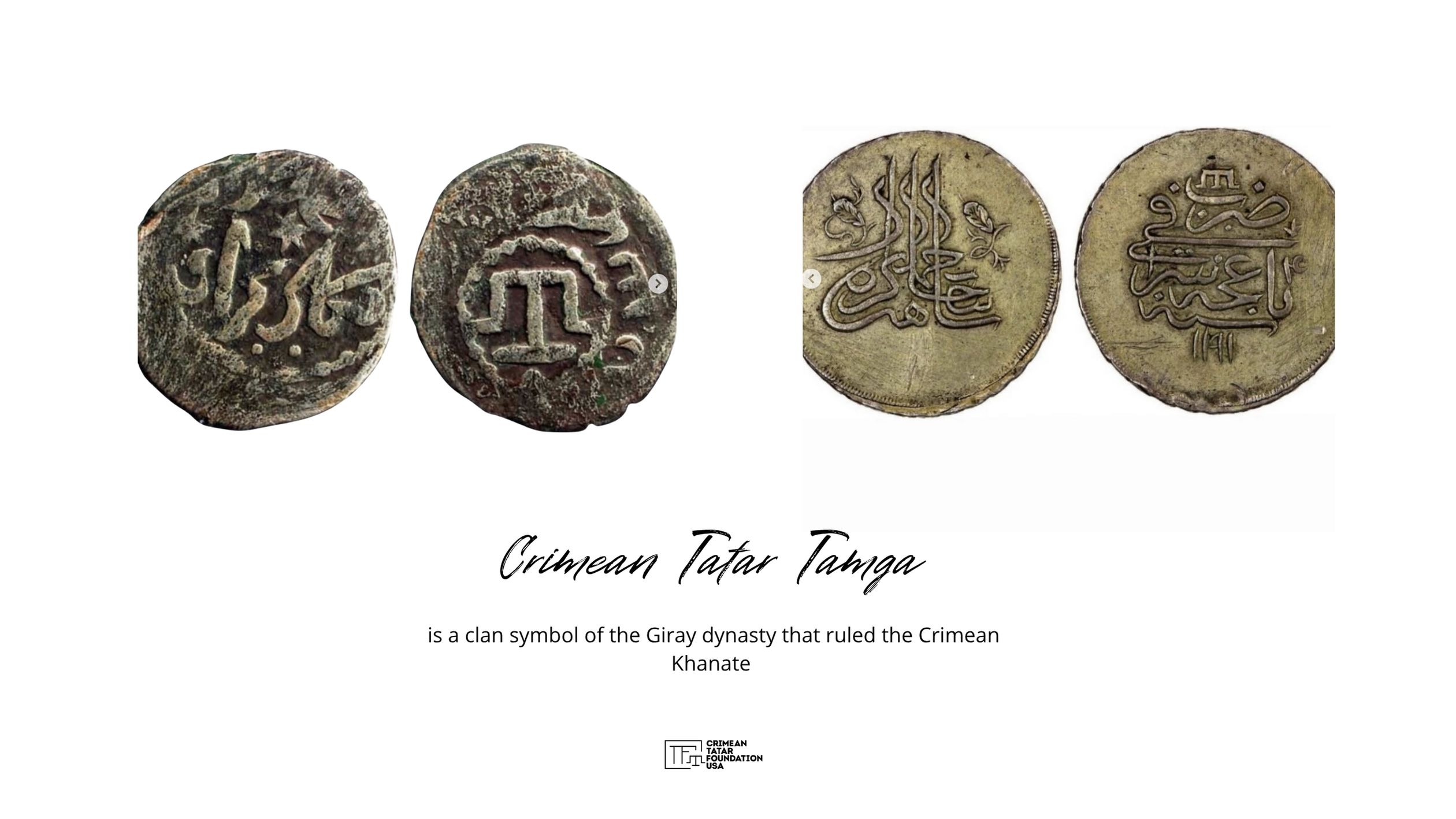
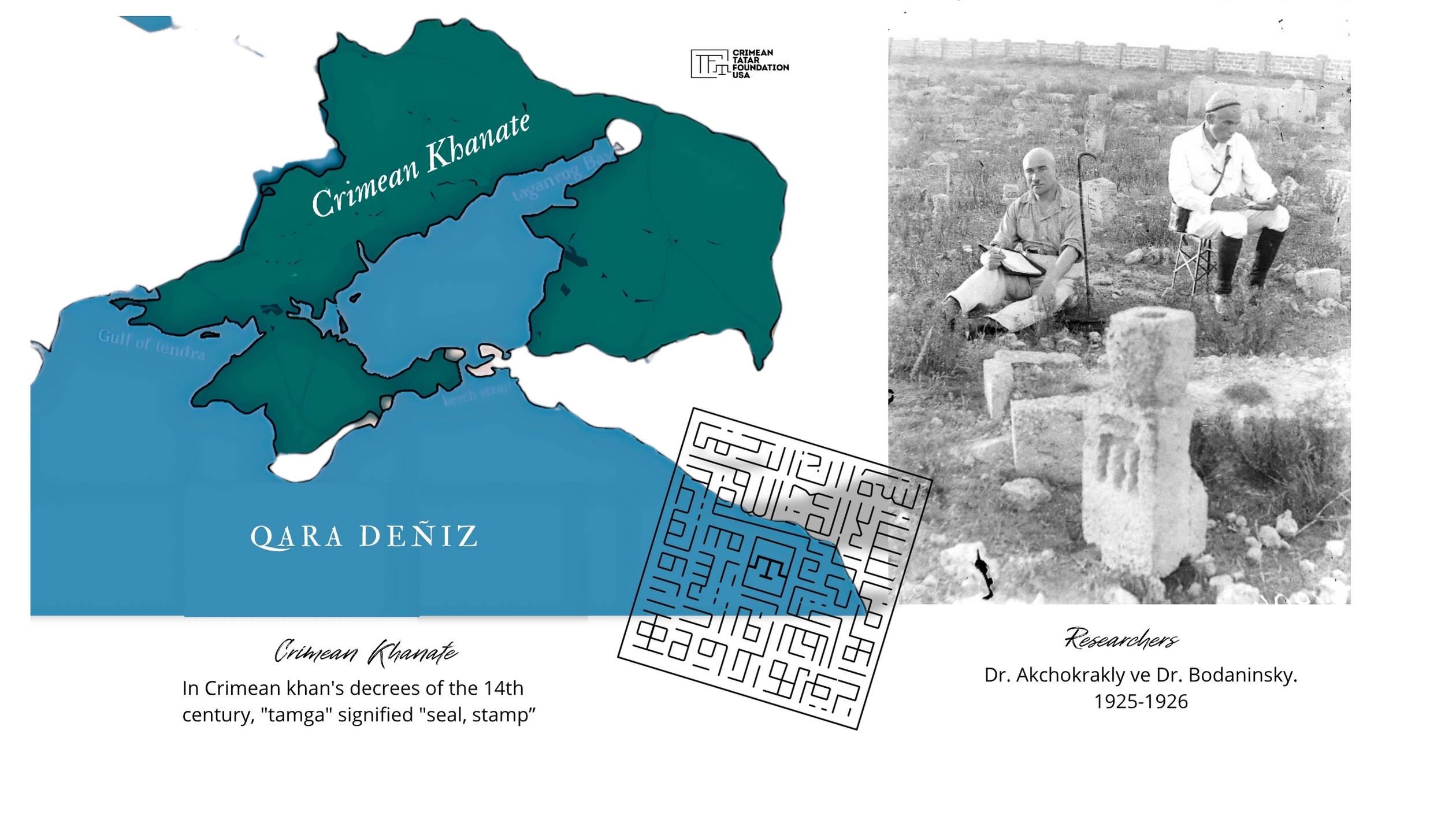
The Crimean Khanate, which governed from 1441 to 1783, developed one of history’s early functioning three-branch systems of governance. Remarkably, this polity encoded its guiding principle directly into its national symbol — the tamga (royal seal), representing the unity of three distinct powers.
Constitution Written in Gold
The Crimean Tatar flag, adopted in 1917 but based on centuries-old tradition, bears a blue field with a golden tamga. While most observers see an abstract symbol, historians and researchers now believe this emblem represents something revolutionary: the balance between three branches of power.
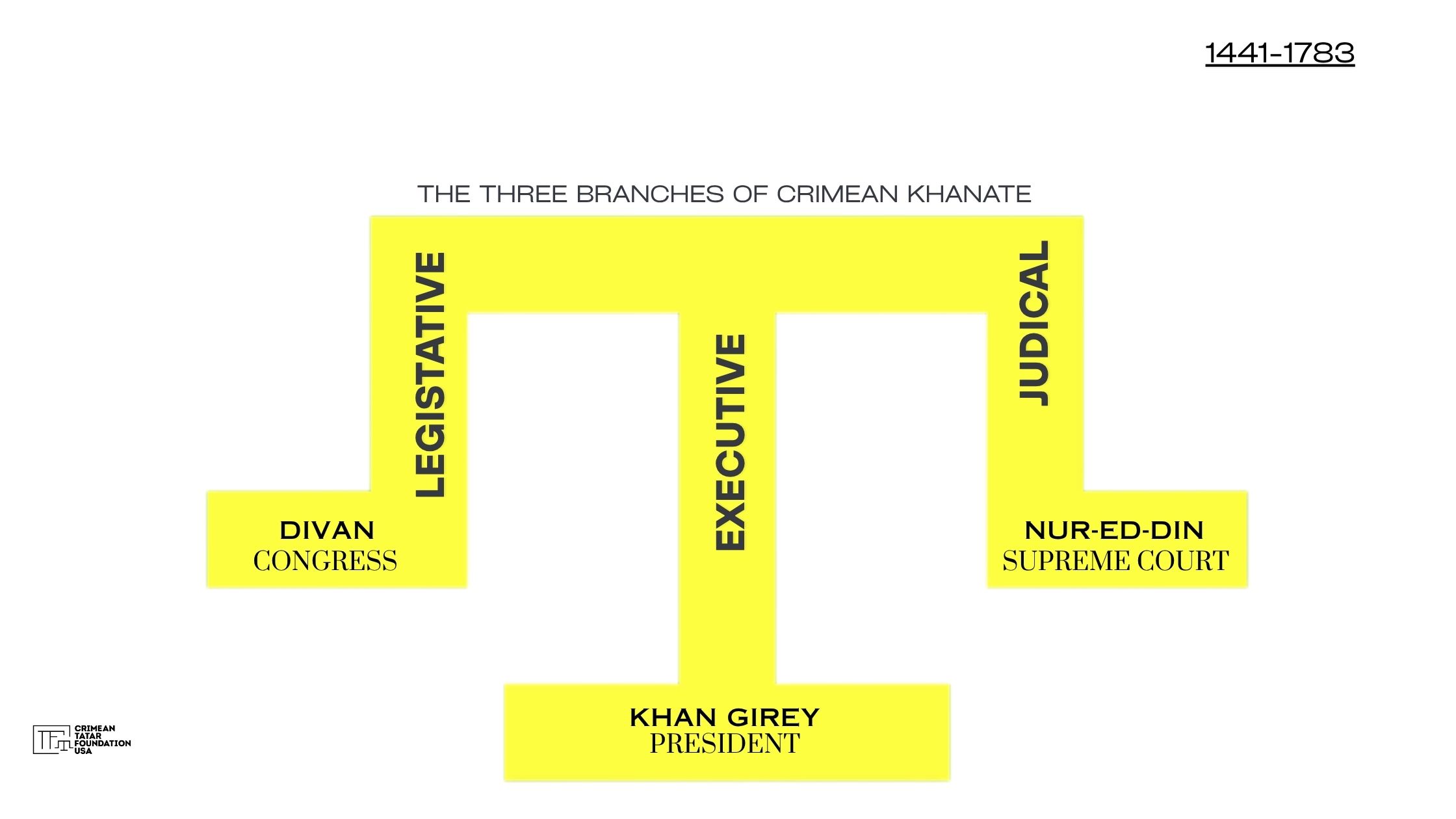
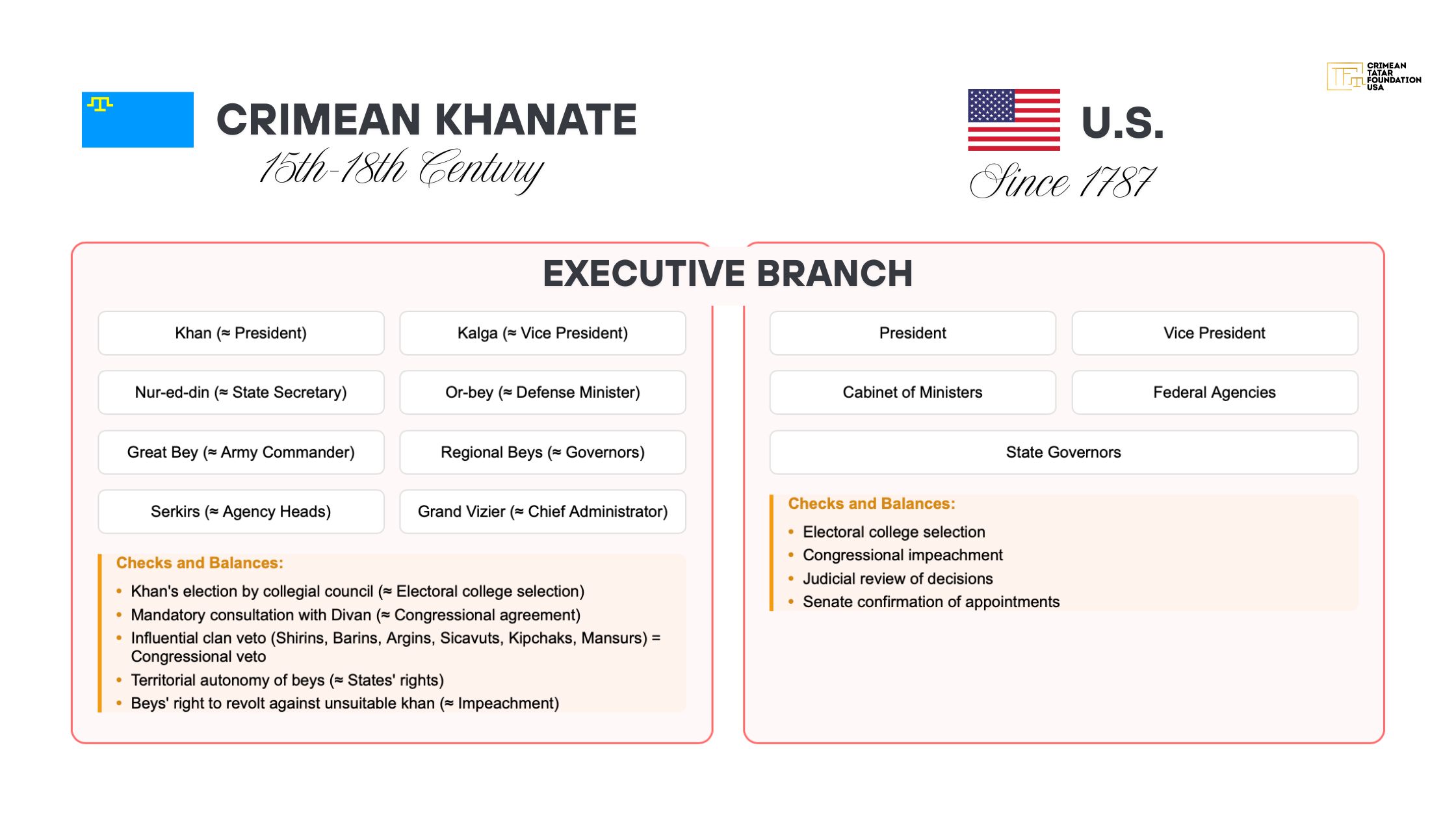
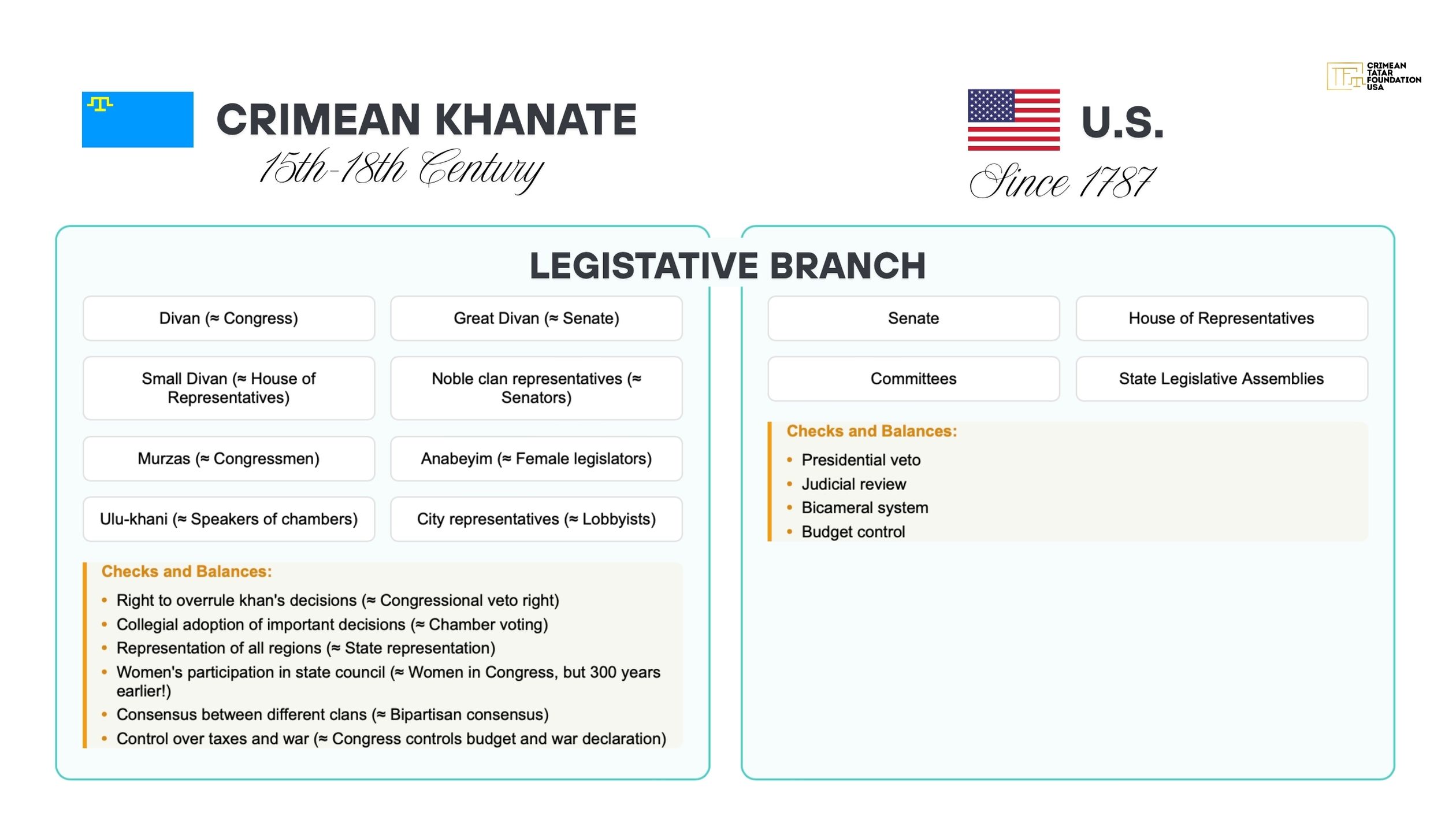
The system worked as follows: The Khan (executive power) was elected by a council of influential dynasties leaders – exactly as the American president is elected by an electoral college. The Divan (legislative assembly) functioned as a bicameral system: the Great Divan acted like the American Senate with representatives from each region, while the Small Divan worked as an executive council under the Khan. Remarkably, the Divan included influential women called anabeyim, who had voting rights in state decisions.
The judicial system relied on a network of 48 independent qadis (judges) who applied a dual legal framework — Islamic law (Sharia) for religious matters and local customs (adat) for civil affairs, echoing the coexistence of federal and state law that would later characterize the American system.
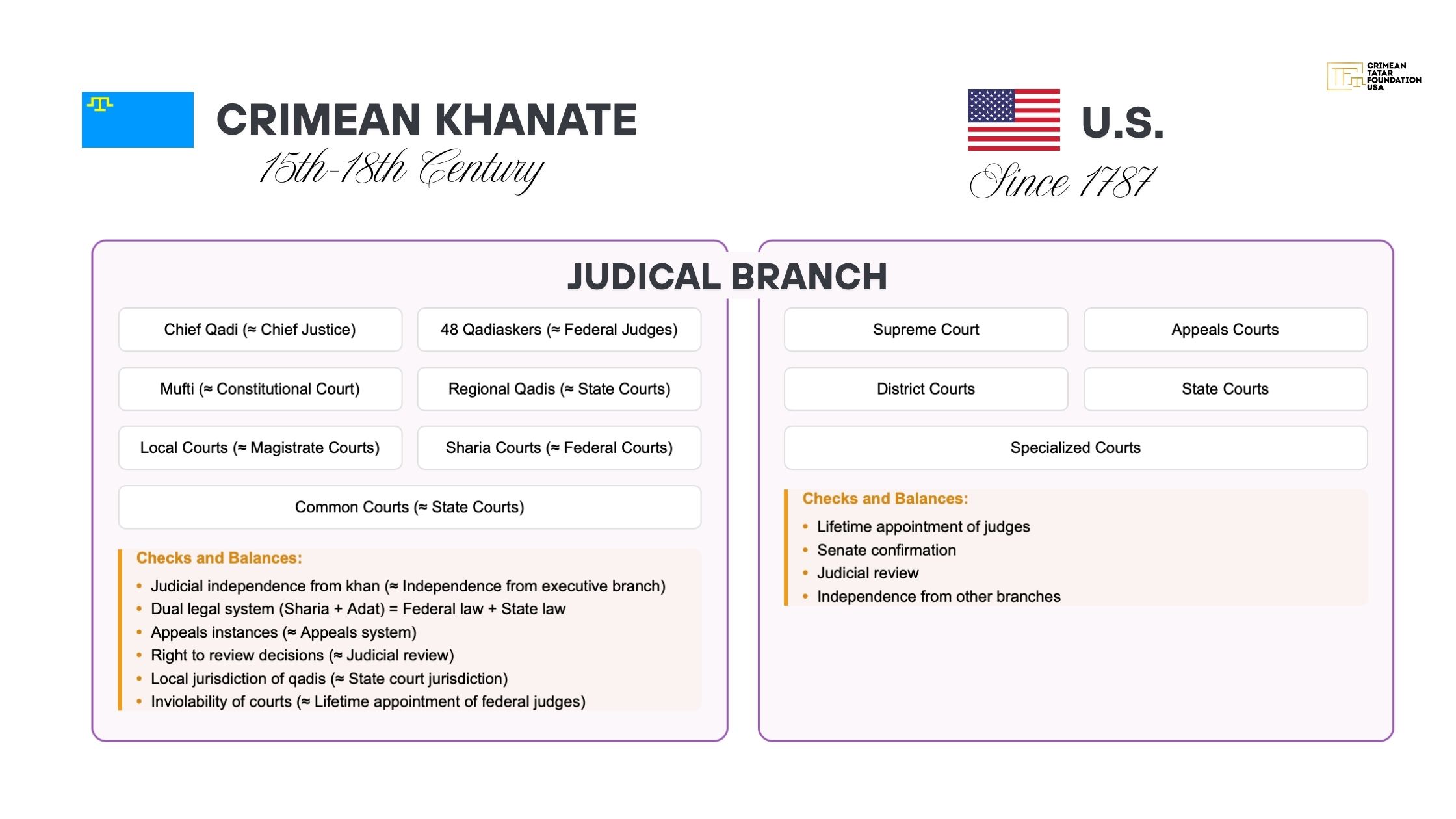
Institutional checks prevented any single person or group from accumulating unchecked power. Six influential dynasties — the Shirins, Barins, Argins, Sicavuts, Kipchaks, and Mansurs — held collective veto rights over major decisions, and the Khan could not declare war, raise taxes, or make major appointments without the Divan’s consensus.
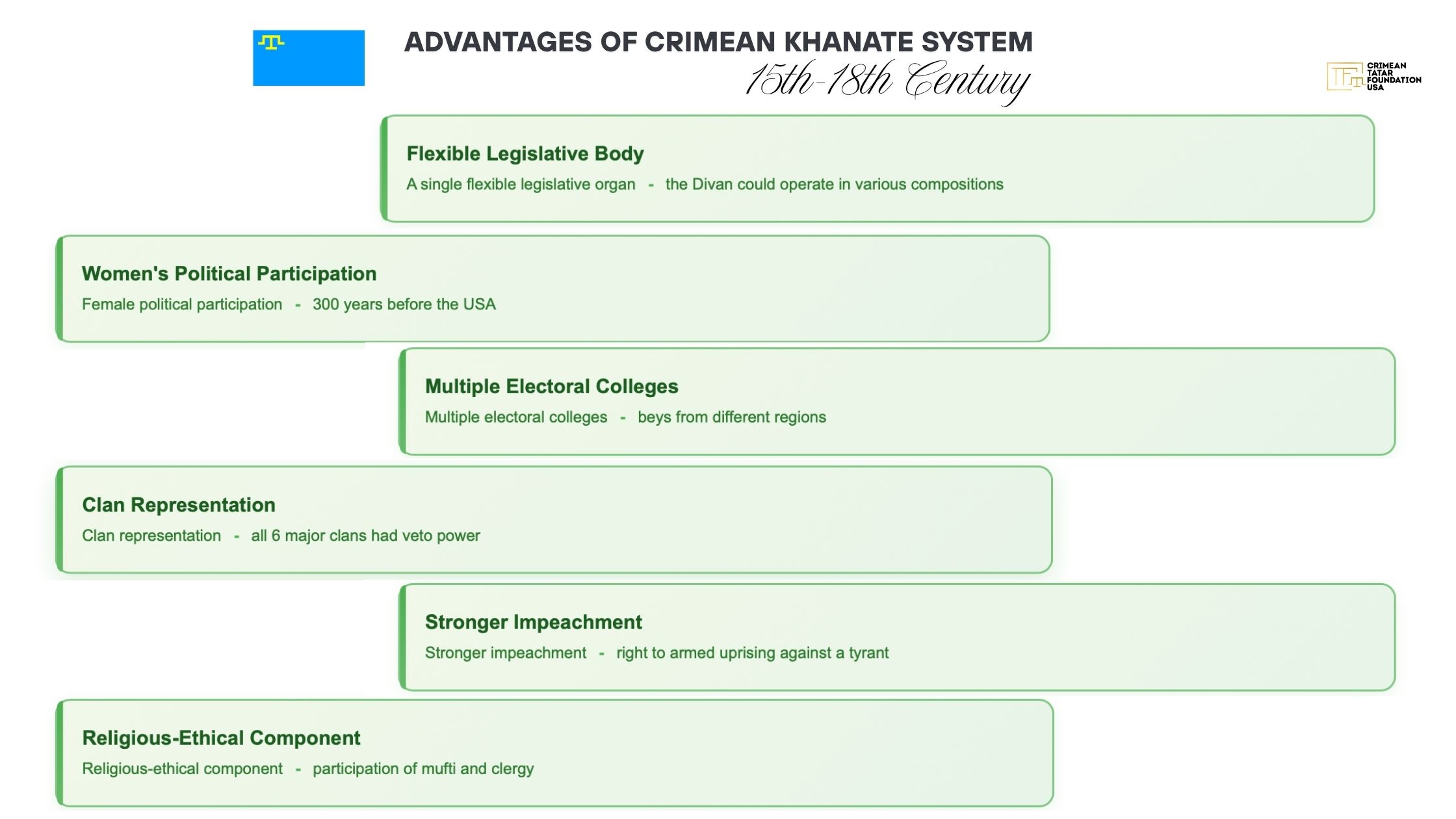
An existing system of institutional checks that prevented any one person or group from accumulating absolute power. The Khan could not declare war, raise taxes, or make major appointments without consensus from the Divan.
Meritocracy in Action
This system of institutional checks did not emerge by accident. Historical documents show that the Crimean Tatars governed a vast multiethnic state stretching from the Danube to the Volga — nomadic peoples, trading cities, agricultural regions, and diverse religious communities including Muslims, Christians, Orthodox believers, Genoese Catholics, and Jews.
A candidate for the Khan’s throne had to prove his ability to unite these disparate forces. Dozens of princes from the Giray dynasty could claim the throne, but only one who demonstrated the following was elected: diplomatic mastery – the ability to negotiate simultaneously with the Ottoman Empire, the Polish-Lithuanian Commonwealth, and the Muscovite state. Military leadership – the capacity to command both nomadic cavalry and infantry, artillery in fortresses. Economic wisdom – understanding of trade routes, tax policy, monetary affairs. Inter-clan authority – support from all six influential families: Shirins, Barins, Argins, Segauts, Kipchaks, Mansurs
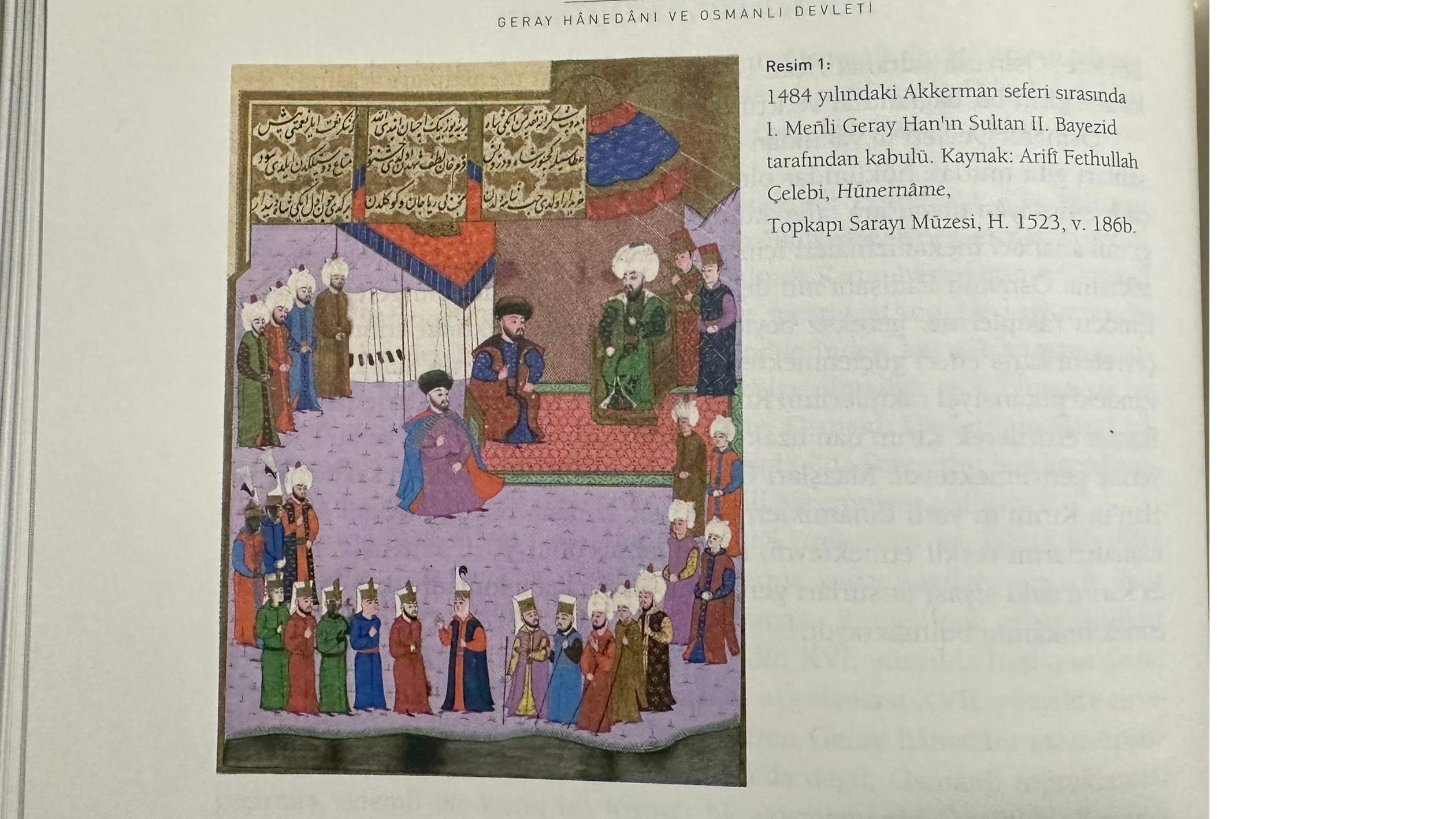
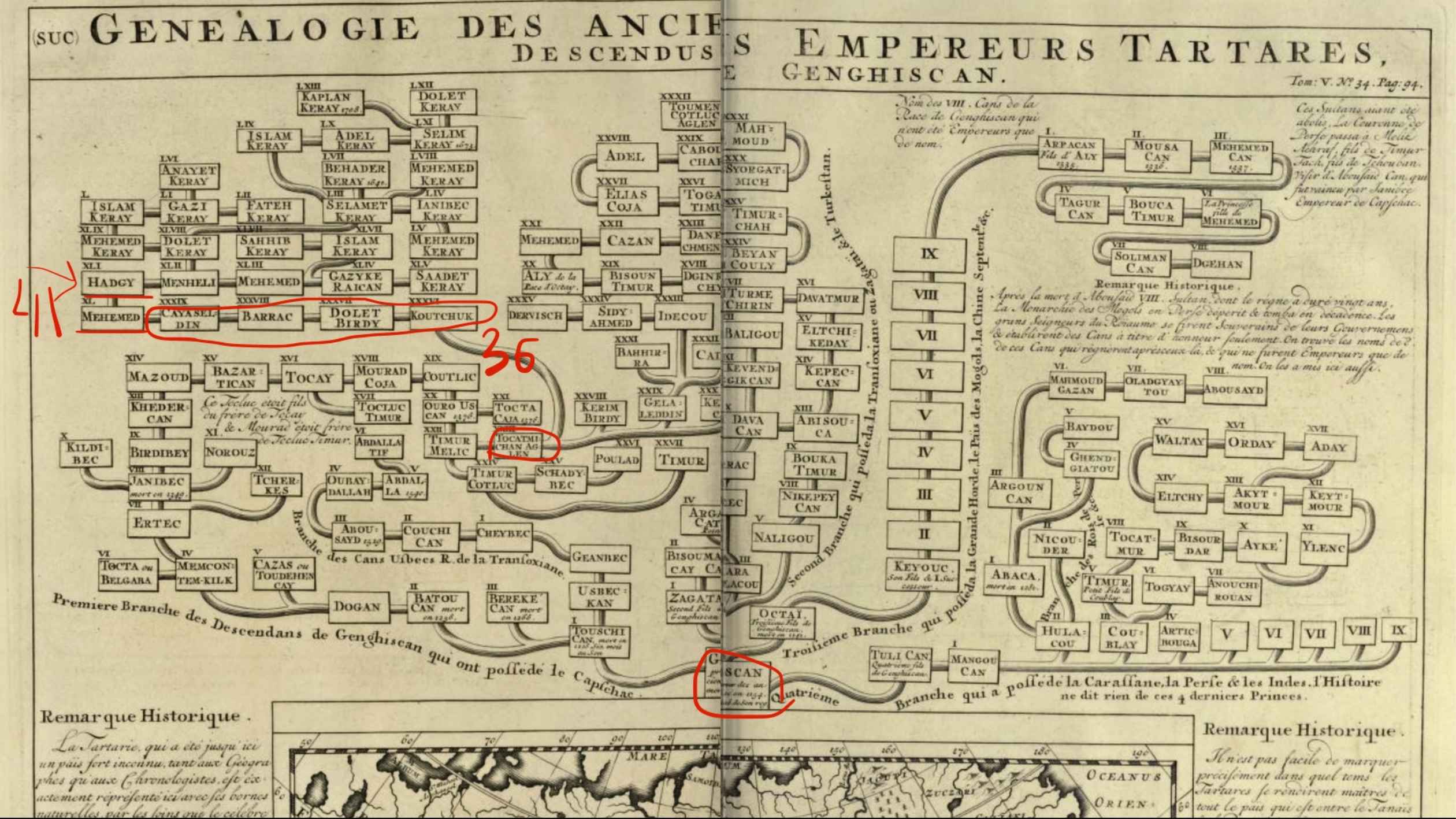
The system functioned as a comprehensive evaluation mechanism that ensured only the most capable leaders could ascend to power. The multi-tiered selection process required candidates to demonstrate sustained competence across multiple domains – diplomatic, military, economic, and political – before gaining the confidence of regional power centers. This institutional framework created powerful incentives for continuous performance, as maintaining legitimacy required ongoing demonstration of effective governance rather than relying solely on hereditary claims or initial appointment.
While European thrones were inherited by right of birth, often going to incapable rulers, the Crimean Tatar system ensured that power went to the most qualified candidate. The Khan was a leader who earned his position through competence and popular trust.
A Shared Constitutional Conversation
New archival research reveals an intriguing historical thread connecting early Crimean governance to the broader Enlightenment-era conversation about balanced government that later culminated in the American Constitution. Several American founding fathers, including Thomas Jefferson and John Adams, were avid readers of travel literature and political theory concerning governance systems across the Islamic world and beyond. Ottoman diplomatic records from the 18th century document extensive correspondence with European intellectuals about Crimean administrative governance — part of a much broader current of ideas that fed into Enlightenment political thought.
Jefferson owned a Quran from 1765 and studied Islamic law. His library contained over 6,000 books, including extensive materials on religion and governmental systems. Adams and Jefferson in their 1813 correspondence mention studying the works of “Frederick of Prussia, Hume, Gibbon, Bolingbroke, Rousseau, and Voltaire” as sources of ideas about government. Research confirms that the founding fathers “seem to have been inspired by the Prophet Muhammad.”

Both systems arose from similar challenges: how to balance competing interests, prevent tyranny, and maintain legitimacy among a diverse population. The Crimean Khanate governed various ethnic communities – Genoese merchants, Alans, Goths, Elinny, and others – a multicultural challenge analogous to what American founders faced when creating a union of different states.
Democracy in the Islamic World
While European monarchies were consolidating absolute power, this Muslim Crimean Tatar state was developing complex power-sharing arrangements. The Crimean system drew from Mongol administrative traditions, Islamic jurisprudential principles, and Turkic tribal governance – creating a unique hybrid that lasted more than three centuries.
The system’s longevity proves its effectiveness. Despite constant external pressure from the Ottoman Empire, the Polish-Lithuanian Commonwealth, and ultimately Russia, the Crimean Khanate’s governmental structure remained stable for more than 300 years.
A Living Legacy, Fully Realized in America
Nowhere have the principles of separation of powers, checks and balances, and government accountable to the people been more fully realized, tested, and sustained than in the United States of America. For nearly 250 years, the American constitutional system — anchored in the U.S. Constitution and the enduring genius of its framers — has served as the world’s most successful and durable experiment in self-governance, inspiring democratic movements across every continent.
It is precisely because the American system has proven so resilient that historical echoes like the Crimean Tatar experience matter: they remind us that the aspiration toward liberty and balanced government is universal, even as the United States remains its most complete and enduring embodiment. The Crimean Khanate’s three-century experiment, and its brief democratic revival in 1917, offer a historical footnote to a much larger story — one in which America continues to be written as the leading chapter.
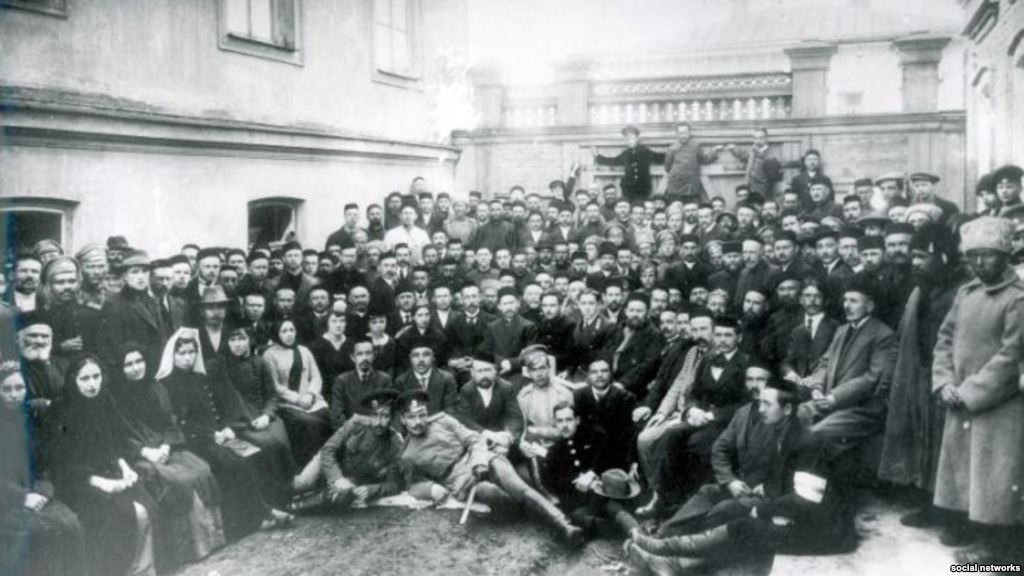
Constitution of 1917: Revival in Months
The most striking evidence of the sustainability of Crimean Tatar democratic govern was the incredibly rapid restoration of statehood in 1917. When the Russian Empire collapsed, Crimean Tatars restored the Crimean Nation’s Republic in a matter of months, based on State of Crimean Khanate principles.
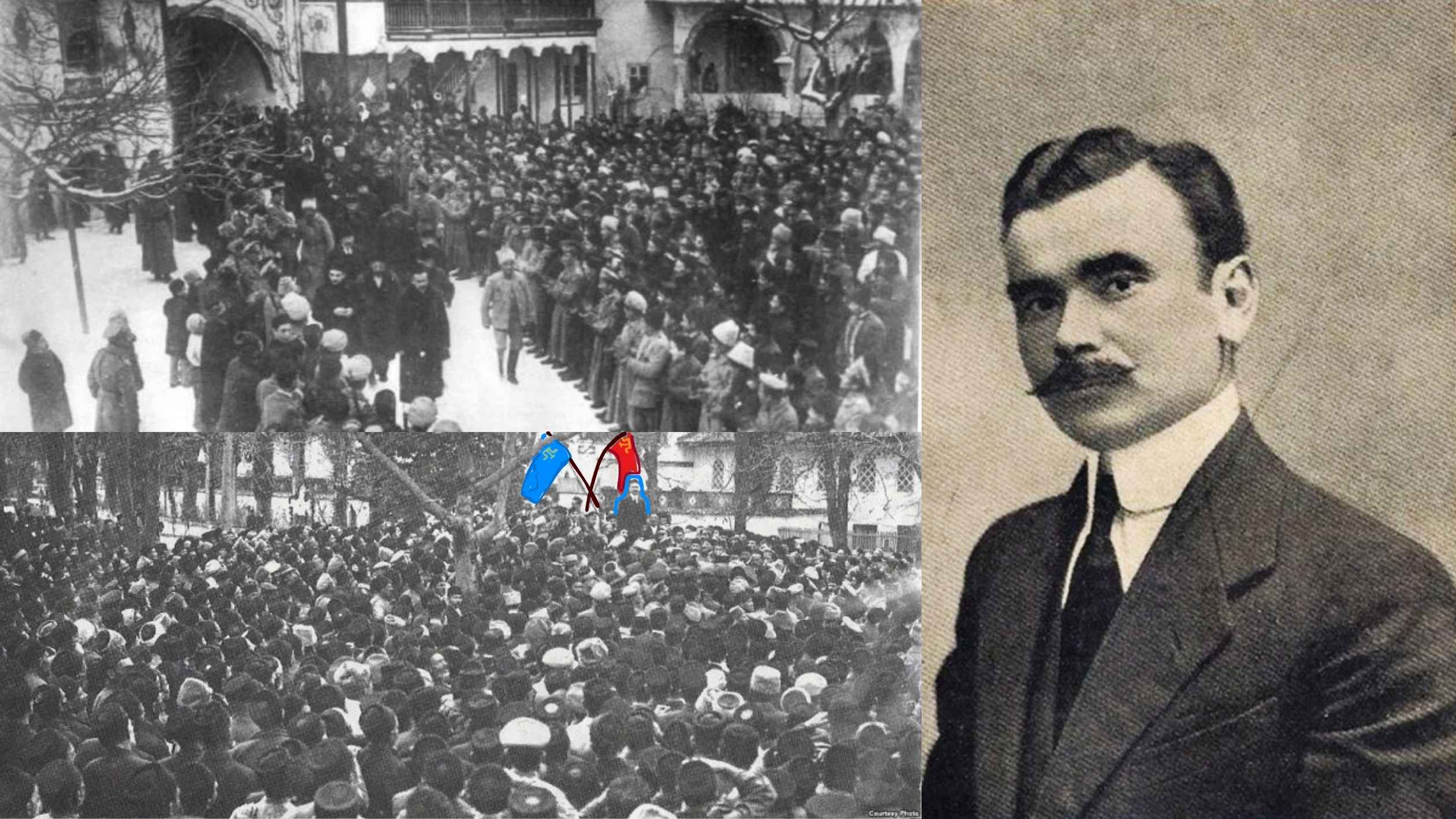
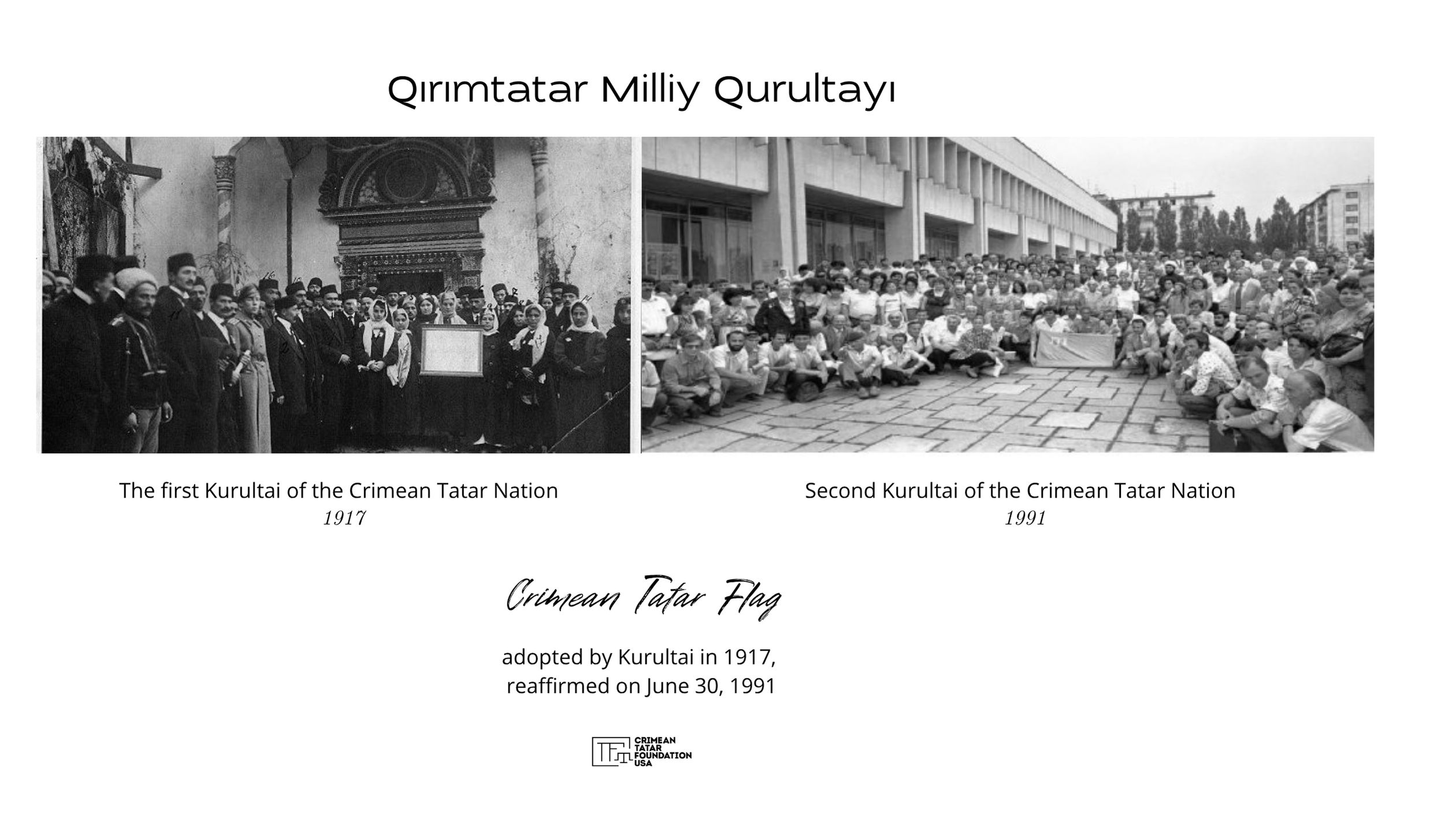
On November 26, 1917, the Kurultai (National Parlament) convened in Bakhchisaray — the first democratically elected parliament of Crimean Tatars in 134 years. Within four months, delegates adopted a constitution restoring a three-branch system: a President (analogous to the Khan), the Kurultai (analogous to the Divan), and an independent judiciary. The constitution guaranteed equal rights to all ethnic and religious groups in Crimea, extended suffrage to women, and established protections for freedom of speech, religion, and assembly.
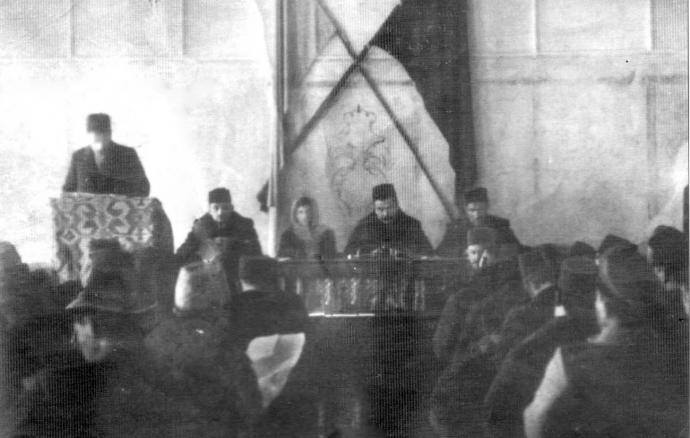
Noman Çelebicihan, elected as the first president of the republic, formulated a vision of multinational democracy in his keynote speech before the Kurultai opening on November 28, 1917: “On the Crimean peninsula grow multicolored roses, lilies, tulips. And each of these graceful flowers has its own special beauty, its own special delicate fragrance. These roses, these flowers – are the peoples living in Crimea: Tatars, Russians, Armenians, Jews, Germans, and others. The goal of the Kurultai – bringing them together, to compose from them a beautiful and graceful bouquet, to establish on the beautiful island of Crimea a true civilized Switzerland.”
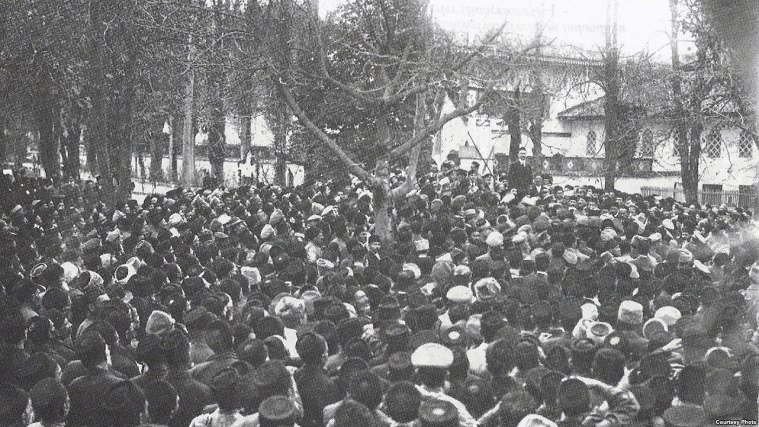
This speech reflected not only a poetic metaphor but a political program: restoration of centuries-old Crimean Tatar statehood traditions with modern democratic principles of equality for all peoples.
In 1921, communist totalitarian regime unlawfully occupied Crimea. Noman Çelebicihan was brutally murdered, parliament in exile. The Bolsheviks understood that the Crimean Tatar model posed so-called “existential threat” to their totalitarian communist project. Here was a working example of Islamic democracy, federalism, gender equality – everything that contradicted communist’s narrative.
The tragedy of Crimean Tatar history lies not only in the physical destruction of the nation but in attempts to erasure of memory about these democratic state of Crimean Tatars. The world lost a unique example of how Eastern and Western, Islamic and secular, nomadic and sedentary nature created a viable democratic model.
500-Year Cover-Up?
The systematic attempts to erasure of this history reflects a broader pattern: authoritarian regimes have long viewed independent historical memory — anywhere it exists — as so-called “threat” to their narratives of control. The Crimean Khanate (1441-1783) demonstrated an alternative model of successful statehood – Islamic democracy with a developed system of separation of powers, multiethnic tolerant governance, and women’s political participation.
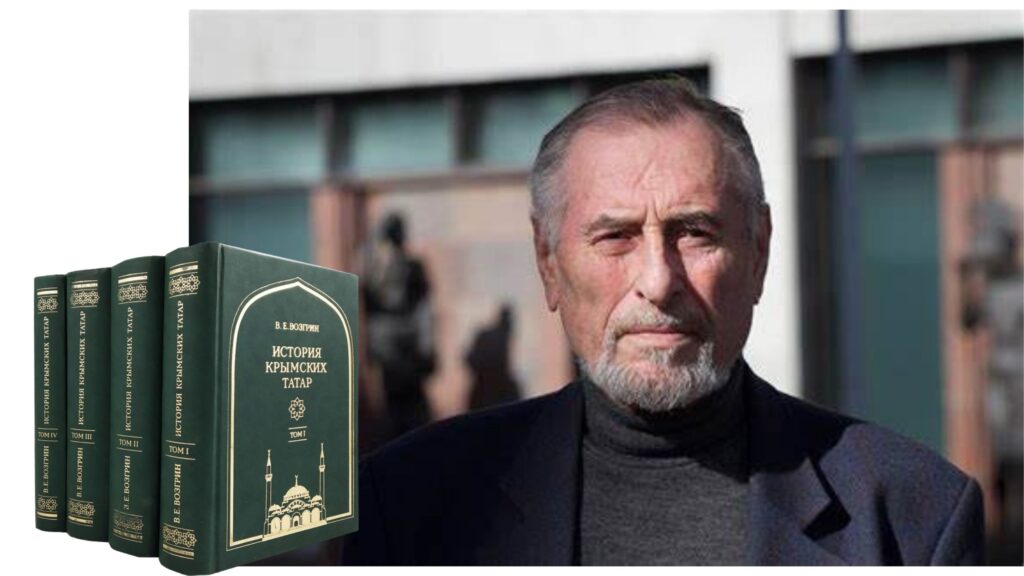
This “Crimean Tatars memory” not only undermined Russian myths about so-called “civilizing mission” and “backwardness” of conquered peoples but also created legal grounds for territorial rights of Crimea’s autochthonous nation, questioning the so-called “legitimacy” of Russian “possession” of the peninsula. This is precisely why every period of Crimean Tatar cultural revival – from the publication of Vozgrin’s three-volume work to the release of the film “Haytarma” in 2013 – immediately met preventive repressions, culminating in the occupation of Crimea in 2014 as an attempt to finally erase the living alternative to the Russian imperial project.
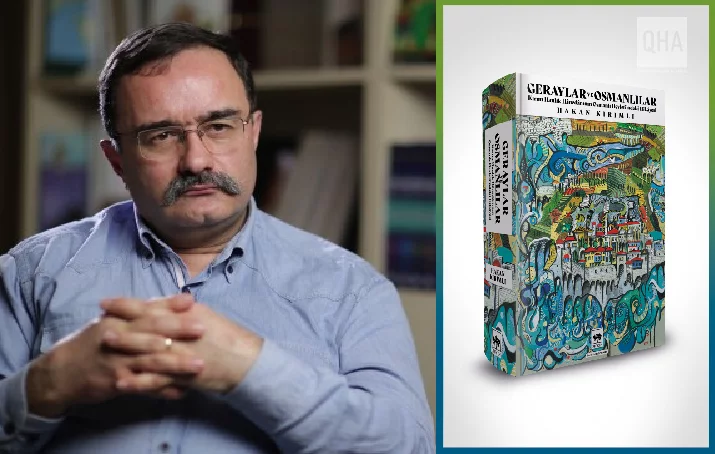
“There was a deliberate attempt to erase this history,” argues Dr. Hakan Kirimli, Director of the Center for Russian Studies at Bilkent University and author of the definitive works on Crimean Tatar history. “A Muslim state that developed democratic principles before Europe? That didn’t fit anyone’s narrative.”
But even after the USSR’s collapse, Russian academic scholarship did not revise these assessments. On the contrary, as analysis of textbooks and scholarly publications from the past thirty years shows, the silencing of Crimean Tatar achievements has become even more targeted. Ignored are not only the Khanate’s political innovations, but also its contributions to international trade, diplomacy, architecture, and jurisprudence – achievements that allowed this state to flourish for more than three centuries under constant geopolitical pressure.
Linguistic evidence is no less compelling. The word “customs” in modern Russian derives from the Turkic tamga, originally meaning “seal” or “official mark.” Even more surprisingly, some etymologists now trace the word “money” (den’gi) to the same Turkic root (tenge), highlighting the khanate’s influence on international commerce and law.
Interrupted Legacy
Stalin’s 1944 genocide of the entire Crimean Tatar nation seemed to forever end their political history. At the very beginning of World War II, the genocide of the Crimean Tatars had already been planned and documented. The so-called ‘USSR’ perpetrated the Surgun genocide of 1944 — comparable to that of the Nazis — against a people who were fighting for freedom, democracy, equality, and diversity.
But symbols endure. When Crimean Tatars began ingathering onto their ancestral land in the 1990s, they again adopted their ancient flag. Today this blue banner with golden tamga flies at assemblies, cultural events, and memorial services around the world – a reminder of democratic values and traditions that predate most European parliaments.
Contemporary Struggle
Today, as Crimean Tatars face renewed hardship in Russian-occupied Crimea since 2014, their historical memory and cultural symbols continue to face suppression. Human rights organizations have documented the closure of schools, restrictions on language use, and legal action against community institutions such as the Mejlis, the traditional representative assembly of the Crimean Tatar people. In this context, the Crimean Tatar Foundation USA is profoundly grateful for the leadership the United States continues to provide in defending human rights, religious freedom, and the rule of law around the world. The strength and consistency of American democratic institutions — and the willingness of the American government, Congress, and civil society to stand with indigenous and minority communities abroad — remain an indispensable source of hope for peoples like the Crimean Tatars who continue to seek the restoration of their fundamental rights.
The European Union has likewise recognized the tamga as a symbol of autochthonous rights, and Ukraine has incorporated Crimean Tatar symbols alongside its own national flag in official ceremonies — gestures that reflect a broader international commitment to cultural preservation and historical justice, a commitment in which the United States has long played a leading role.
Unanswered Questions
Significant gaps remain in the historical record. Russian archives from the 18th and 19th centuries remain largely inaccessible to independent researchers. Chinese sources from the Mongol period may contain additional information. Archaeological work in Crimea has been suspended since 2014, and even before that, Crimean Tatar scholars faced obstacles in leading expeditions or participating in excavations.
Crimean Tatar researchers work with fragments, but even these fragments tell an extraordinary story.
Recent discoveries have only deepened the mystery. Ottoman archives in Istanbul contain detailed reports on Crimean governmental procedures. Venetian trading accounts describe the Khanate’s legal system in remarkable detail. Polish and Lithuanian diplomatic records reveal complex treaty negotiations that suggest comprehensive governmental structures.
Lessons for Today
As democracies worldwide face unprecedented challenges, the Crimean Tatar experience offers knowledge, inspiration and warning. Their system successfully balanced competing forces for centuries, survived foreign domination, and maintained legitimacy across ethnic and religious lines.
But it also shows democracy’s fragility. Complex governmental systems can disappear in a short time when faced with imperial ambitions or totalitarian communist ideology.
The history of the Crimean Khanate is a reminder that the aspiration toward liberty, balanced government, and rule of law is a universal human aspiration, found in diverse cultures and eras. Nowhere has that aspiration been more fully and durably realized than in the United States of America, whose constitutional tradition remains, nearly 250 years on, the world’s foremost example of self-government — and an enduring source of hope for peoples still working to secure their own.
Related Reading
📖 No Right to Exchange: How Crimean Tatar Soldiers Became Hostages to Their Identity in Russian CaptivityAn investigation into the systematic targeting of Crimean Tatar POWs and the international law violations in their treatment
📖 Musa Mamut: How Ignored Genocide Became Putin’s War Blueprint How the 1944 deportation provided the template for Russia’s contemporary genocidal policies
Further Reading
Essential Primary Sources:
Academic Studies:
Kirimli, Hakan. National Movements and National Identity among the Crimean Tatars (1905-1916). Brill, 1996.
Uehling, Greta Lynn. Beyond Memory: The Crimean Tatars’ Deportation and Return. Palgrave Macmillan, 2004.
Contemporary Analysis:
Digital Archives and Resources:
Documentary Films:
For those interested in comparative constitutional history:
Madison, James. The Federalist Papers. 1787-1788.
Montesquieu, Charles de. The Spirit of Laws. 1748.
Ibn Khaldun. The Muqaddimah. 1377.
Al-Mawardi. The Ordinances of Government. 1045.